Michael Jackson's Lyrical Evolution
About: Michael Jackson
Michael Jackson, often hailed as the "King of Pop," embarked on an extraordinary journey from a child prodigy in the Jackson 5 to a global icon whose influence transcended music. Born in Gary, Indiana, in 1958, Jackson's early exposure to music and performance set the stage for a career marked by groundbreaking achievements and profound impact. His journey was not just one of fame and success but also of constant evolution, both personally and artistically.
This research delves into the heart of Jackson's artistry - his lyrics. Through our analysis, we explore how his words mirrored the changes in his life, reflected the times he lived in, and how they resonated with millions worldwide. From the early hits that made him a household name to the introspective and often provocative themes of his later work, Jackson's lyrics serve as a window into his soul and a mirror of the society he lived in.
Primary Sources:
Questions About the Sources:
Analysis:
Findings:


Narrative Findings
Questions...
We are hoping to find some correlation between the specific word choice used in Jackson’s lyrics and the popularity of his songs, so here are the burning questions that we thought of:
- How did Michael Jackson's lyrics change as he skyrocketed in popularity?
- Are there noticeable differences in word choice or word frequency as Jackson became a mainstream star?
- What do these changes in lyrics reveal about the changing messages in his songs?
- What does this suggest happens to an artist’s music as they become mainstream?
Scholars/Thinkers Perspective
Arguments
Thesis: This project aims to cross-reference Michael Jackson's complete lyrical data with Billboard Top 100 chart performance to identify correlations between his lyrics and song success. Additionally, we will analyze how Jackson's lyrics evolved over time and across his albums. This approach will not only explore the impact of lyrical themes on commercial success but also trace Jackson's artistic development, offering insights into the interplay between his evolving lyrics, personal life, and chart trends.
From our research we've taken away:
- The evolution and growth of popular artists change as they develop to be more mainstream.
- Being in the public eye holds weight and affects the cultural proponents of a musical celebrity–
- How lyrics are defined by cultural and societal movements
- How much an audience influences the growth and popularity of their favorite artist
- How becoming mainstream affects the products that an artist puts out to the public to consume.
The Media Above shows detailed Highlights from Michael Jackson's career, including:
Figure 1: What Years were MJ's Songs the most popular? - This Graph highlights the most popular years of Michael Jackson's career using the average peak rank of his songs, the total rank of all the songs on the Billboard 100 in that year, and the total weeks on the Billboard 100
Figure 2: Total Number of Weeks on the BillBoard100 - This graph shows similar information to Figure 1. It lists this information by song, along with the year it made the list.
Figure 3: Billboard Entry Minimum (Best) Rank - This graph details the average rank of each song in chronological order. It's important to note that a lower average equals a higher placement on the Billboard 100.

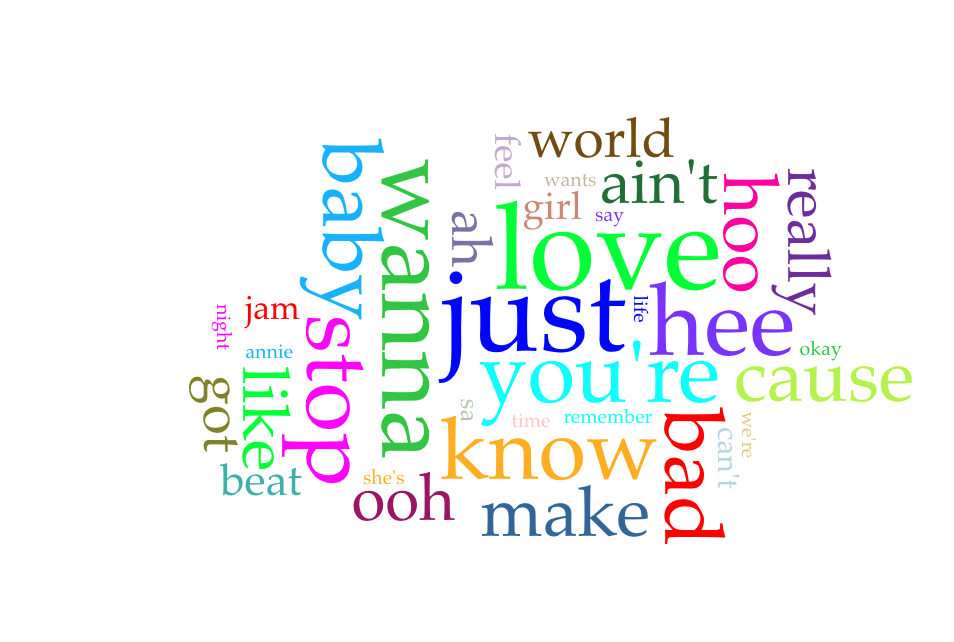
Voyant word bubble for the most popular words in Michael Jackson's songs that were on the Billboard Hot 100 list.
Voyant word bubble for the most popular words in Michael Jackson's songs that were on the Billboard Hot 100 list.

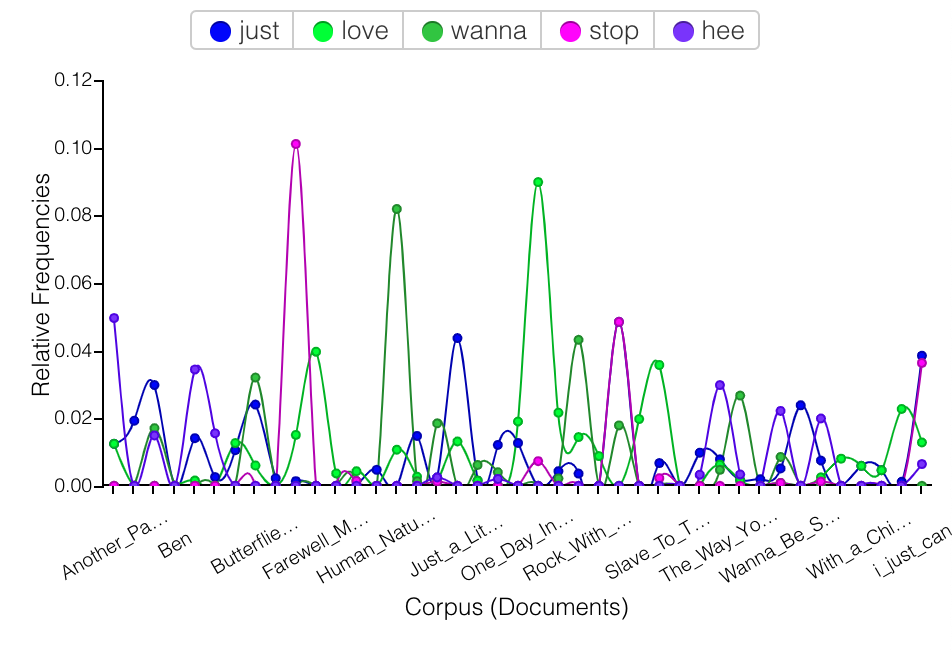
Voyant graph of frequency of top 5 most popular words
Voyant graph of frequency of top 5 most popular words
Word Clouds : MJ's Billboard Hits
Using Voyant, we first looked at 41 MJ songs that were on the Billboard 100 list at any point in time; these serve as his most popular songs. From this tool, we can see what his most commonly used words are and where they are used the most. "Just,' "love," "wanna," "stop," and "hee" are his most used words throughout his most popular songs.
Words like "wanna," "just," "love," "you're," and "know" are among the largest, indicating their frequent use in his lyrics. These words reflect the themes of desire, immediacy, affection, personal connection, and understanding, which are common in popular music and were certainly a significant part of Jackson's songwriting.
"Bad," "world," "girl," and "baby" also stand out, hinting at the varied subject matter of his songs—from self-assertion and global themes to more intimate and personal relationships. The repetition of terms like "hee," likely a reference to his signature vocalizations, adds a unique element to his lyrics, setting them apart from other artists.
The presence of action-oriented words like "make," "stop," and "beat" suggests a strong sense of movement and rhythm, which is fitting given Michael Jackson's reputation as not just a singer but also a groundbreaking performer and dancer. Words like "night" and "feel" might relate to the sensory and emotional experiences conveyed in his music.
This word cloud not only serves as a textual representation of Michael Jackson's lyrical themes but also as a visual representation of the language that defined his presence in the music industry, particularly in the context of his commercial success as reflected by the Billboard charts. Jackson's trademarked slogan, "hee hee," shows up in the top 5 words, indicating how much he uses this sloagn throughout his songs as well.
Lyrical Analysis: Billboard Hits By Album

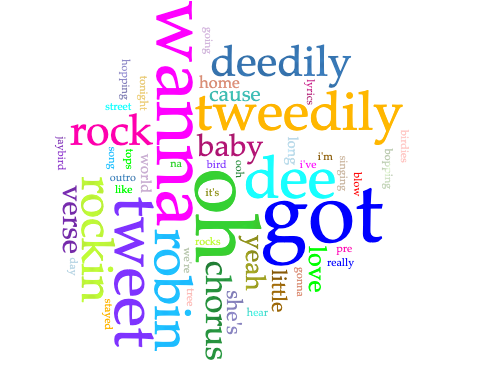
Got to Be There
Words like "rock," "baby," "music," and "got" suggest a youthful, vibrant energy which is fitting given that this was Michael's debut album as a solo artist. The presence of the word "tweedily," which is part of the song "Rockin' Robin," a major hit from this album, reflects the playful tone of some of the tracks.

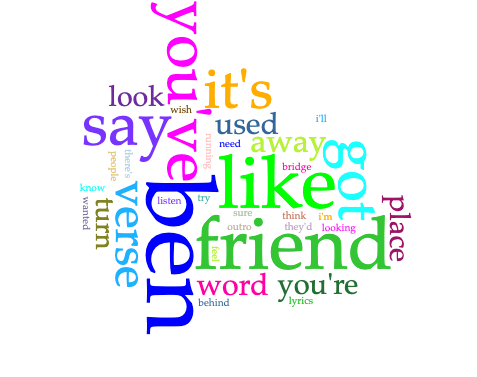
Ben
With this word cloud, "ben" the name of the main song, is also the most repeated word. Additionally, there are no interjected phrases in this album's famous songs. Here, the most prominent word is "friend," reflecting the title track "Ben," which is a song about friendship. The words "say," "feel," and "you're" imply a personal and emotional connection, which aligns with the sentimental and gentle nature of the album's songs.
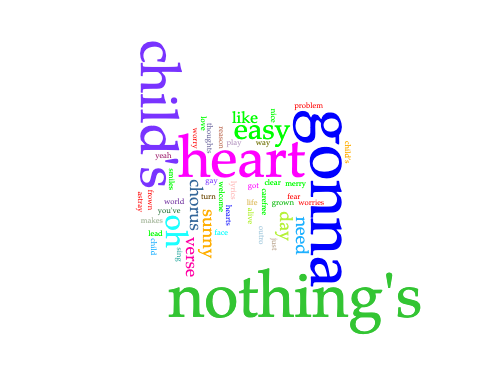
Music and Me
"Child," "heart," "gonna," and "nothing's" stand out, emphasizing the album's themes of innocence and the joys of youth. This album is known for its introspective tracks that often reflect on childhood and the comforting aspects of music in one's life.
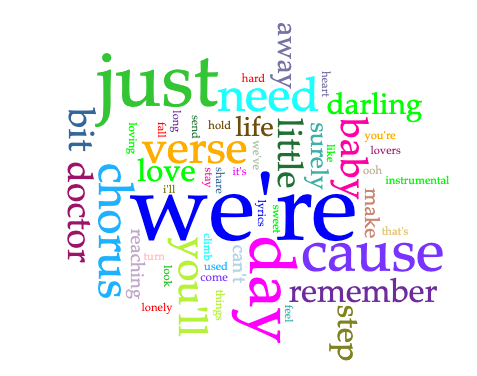
Forever, Michael
Words like "love," "we're," "just," and "remember" indicate a focus on relationships, memories, and emotional reflection. This aligns with the maturing sound and content of this album as Michael began transitioning from his child star image to a more mature artist.
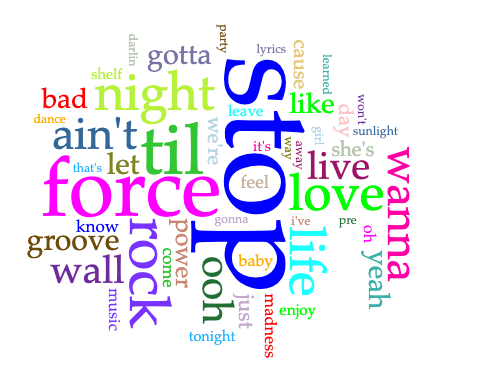
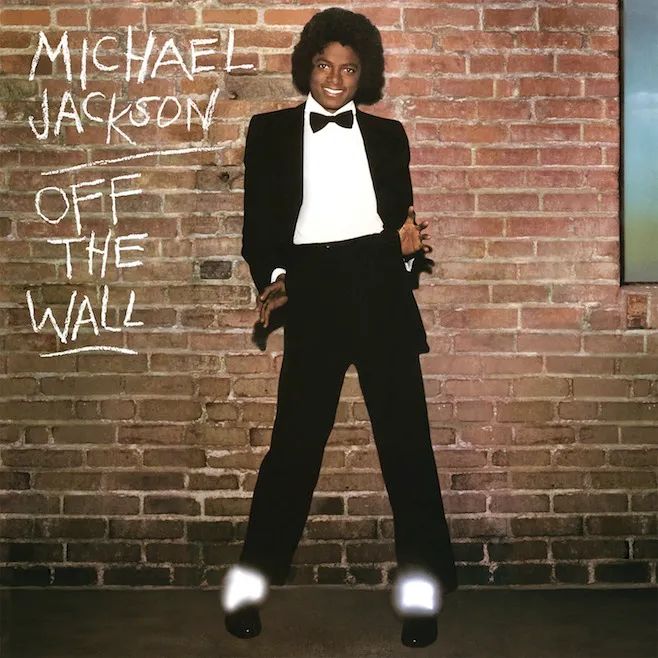
Off the Wall
MJ turned into a superstar after released his fifth album - Off the Wall. From having only 2-3 popular songs per albums, this time around , 4-6 of his songs got popular on Billboard. Therefore, we expected to see some differences between his first four albums and Off the Wall.
The word cloud for Michael Jackson's "Off The Wall" album features prominent words like "force," "love," "night," "life," "feel," and "baby," which are central to the album's themes of enjoyment, romance, and vitality. "Off The Wall" marked a significant shift in Jackson's career toward a more sophisticated sound that blended funk, disco, R&B, and pop.
"Love" and "baby" are typical in songs that deal with relationships and personal connections, which are recurrent themes in Jackson's work. Words like "feel," "life," and "live" suggest a deep emotional resonance and an emphasis on the experience of living to the fullest, which is a key aspect of the album's spirit.
Based on the analysis, we found that amount of interjection words used increased in his superstar period. We hypothesized that interjection words increased would also means an increasing in emotional expression, and thought emphasizing which we followed up by a sentiment analysis.
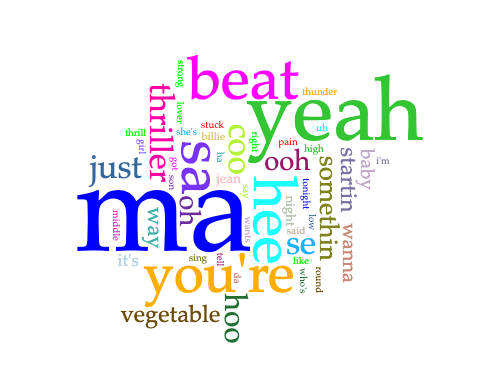
Thriller
The prominence of words like "man," "dance," "beat," and "night" highlights the energetic and rhythmic nature of the album, which is often associated with upbeat music suitable for dancing. The word "thriller" itself indicates the album's famous title track, which is known for its supernatural themes and iconic music video. The presence of words like "eyes," "feel," and "see" suggests a focus on sensory experience, which is a hallmark of the immersive storytelling in "Thriller."
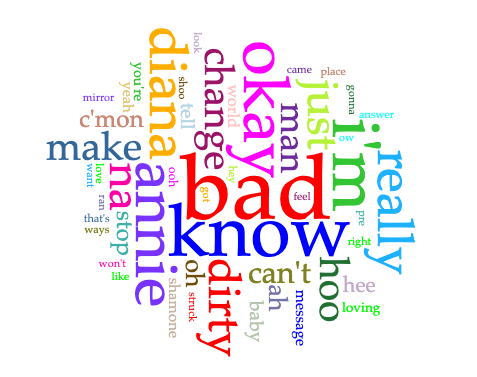
Bad
This word cloud features "bad," "really," "know," and "ain't" as prominent words, reflecting the defiance and confidence expressed in the album's title track. The repetition of "you're," "your," and "you" indicates a direct engagement with the listener or another subject, which is a common technique used by Jackson to create a personal connection through his music. The terms "mine" and "man" suggest ownership and self-assertion, themes that run through the album.
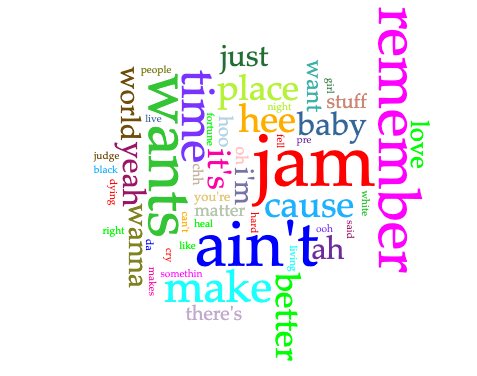
Dangerous
In this cloud, "world," "jam," "ain't," and "love" stand out. "Jam" likely refers to the song of the same name, which has a strong message about coming together to make the world better. "World" and "love" reflect the album's broader themes of global harmony and personal relationships, while the informal contraction "ain't" points to the conversational and sometimes confrontational tone present in the lyrics.
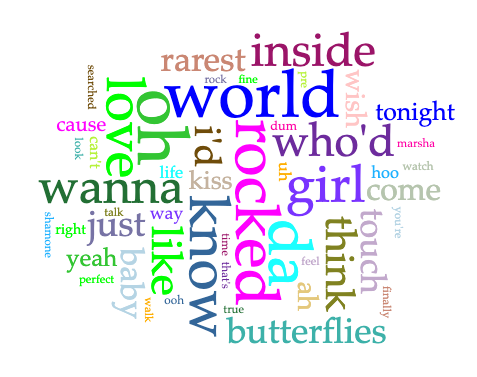
Invincible
Here, "girl," "love," "world," and "butterflies" are quite visible. "Girl" and "love" suggest songs focused on romantic relationships, which is consistent with the more personal and introspective nature of some tracks on "Invincible." The word "butterflies" references the light, fluttering feeling of new love and also directly relates to the song "Butterflies." The use of "world" could indicate a continued theme of universal concepts and connections beyond the personal scope.
How Did Michael Jackson's Lyrics Evolve Over Time? An album by album Word Frequency Analysis
The journey of Michael Jackson's music, as captured by the thematic essence of his albums, narrates a story of profound evolution from a bright-eyed prodigy to a world-renowned pop icon. "Got to Be There" marks the inception of his solo career, with words like "baby," "music," "rock," and "girl" painting a picture of youthful exuberance and a budding pop sensibility. As we transition to "Ben," a maturation occurs—words such as "friend," "feel," "say," and "you're" reflect a pivot towards introspection and the complexities of emotional bonds, signaling a deepening in lyrical content.
"Music and Me" continues this trend, with "child," "heart," "easy," and "gonna" evoking a nostalgic embrace of childhood innocence and a soothing, melodious approach to life's narratives. "Forever, Michael" introduces a sense of retrospection and romantic maturation, with "love," "we're," "just," and "remember" suggesting a nuanced reflection on past experiences and relationships.
"Off The Wall" represents a seismic shift in Jackson's musical journey, embodying the kinetic energy of the dance floor with "night," "force," "groove," and "life." This album captures the essence of living in the moment, propelled by the disco-infused beats that would become a hallmark of his sound. The epochal "Thriller" further cements Jackson's icon status; words like "thriller," "beat," "man," and "dance" illustrate an album that is at once an international sensation and a masterclass in musical innovation, blending haunting narratives with an irresistible rhythm.
With "Bad," the lexicon of "bad," "ain't," "you're," and "know" indicates an artist at the height of his confidence, challenging listeners and the industry with his boldness and self-assured artistry. By the time we reach "Dangerous," the language of "world," "jam," "ain't," and "baby" marks a sophisticated blend of social consciousness and personal narrative, showcasing Jackson's growing engagement with global themes without losing the intimate touch that marked his early work.
Throughout these albums, Michael Jackson's evolving vocabulary mirrors his artistic progression, from the simple, heartfelt messages of his youth to the intricate, globally resonant themes that defined his later works. His ability to adapt and innovate, all while retaining a core of emotional authenticity, is what solidifies his enduring legacy in the annals of music history.

Sentiment Analysis :Polarity and Subjectivity of MJ's Entire Discography
To analyze how Michael Jackson's song sentiments relate to their popularity (as indicated by views) and how they have changed over time, we conducted the following analyses:
- Sentiment Over Time: Analyze the trend of sentiment scores over the years to see if there's a shift in the emotional tone of the songs.
- Popularity vs. Sentiment: Examine the relationship between the sentiment scores and the song's popularity (views) to see if there is a correlation.
- Subjectivity Over Time: Look at how the subjectivity of the songs has evolved over the years.
- Genre Analysis: Explore if the sentiment and subjectivity vary significantly across different genres (e.g., pop, rock).

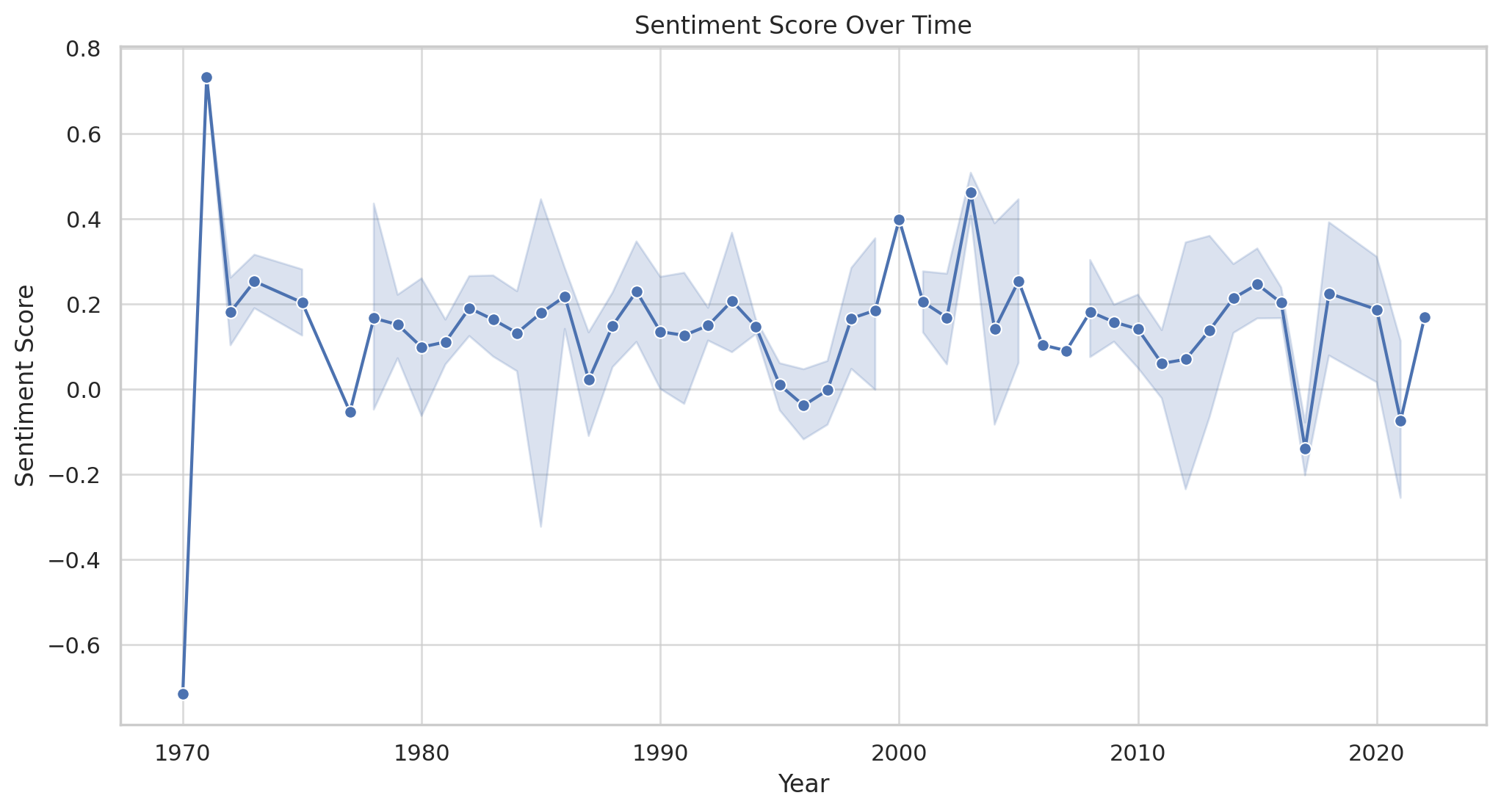

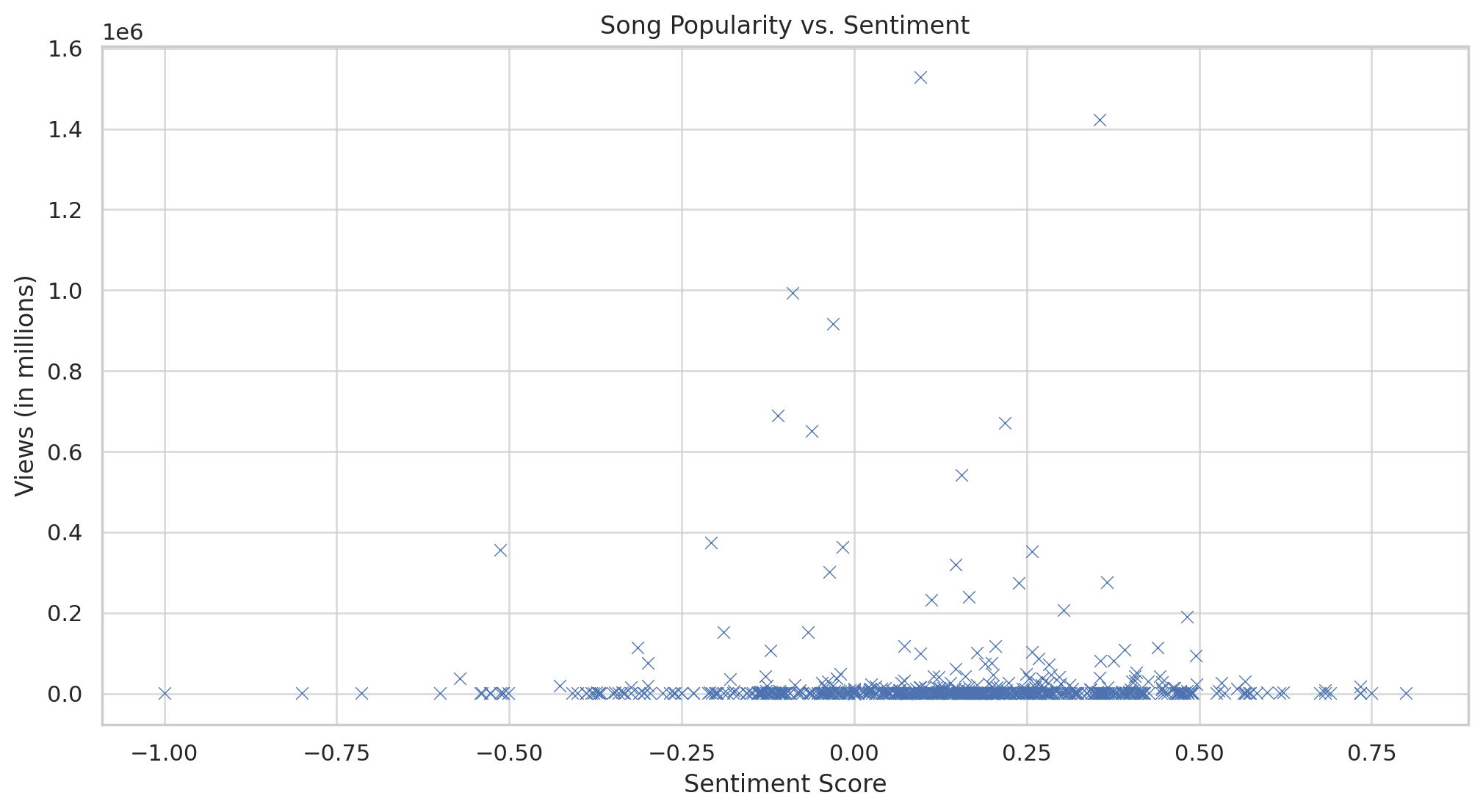
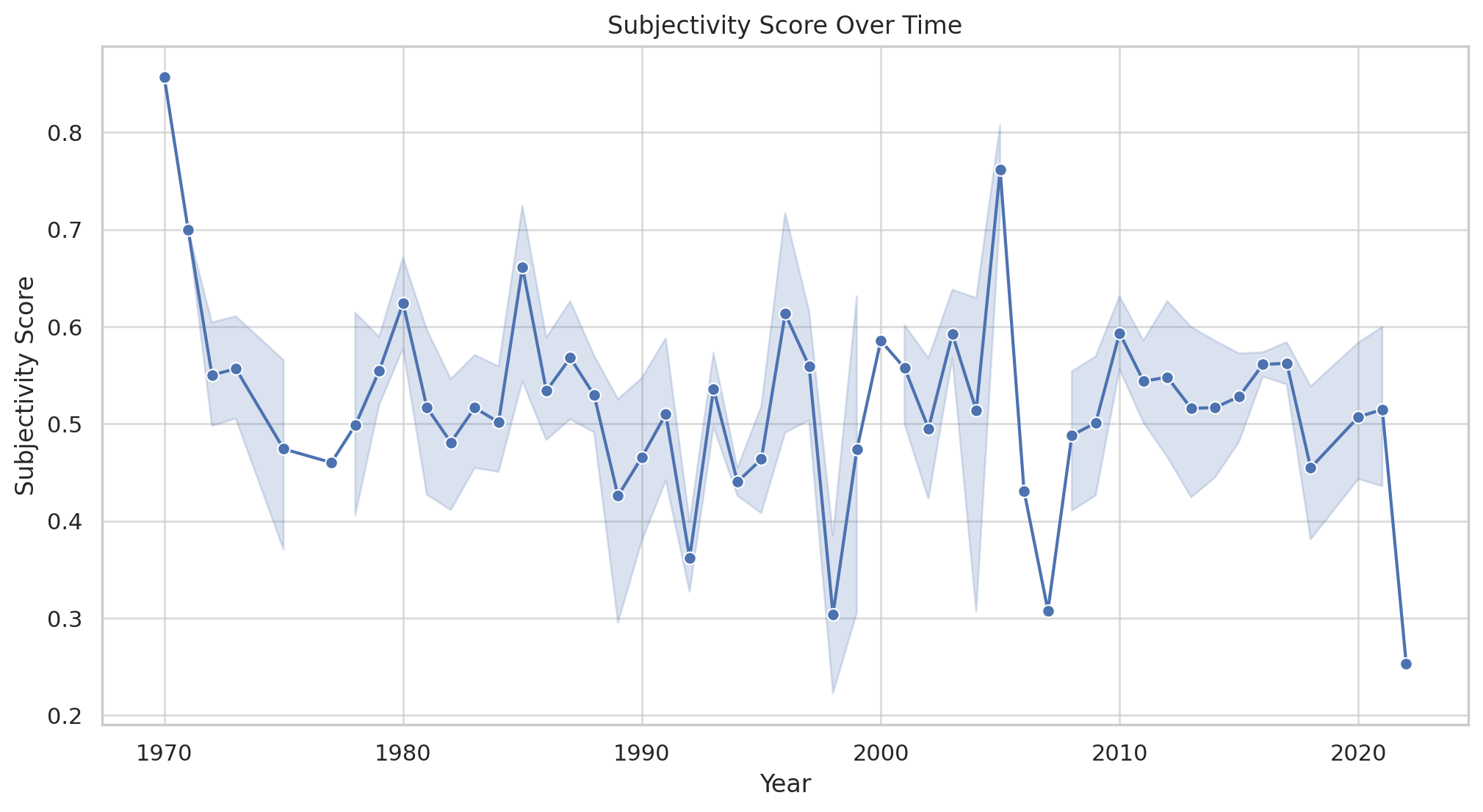

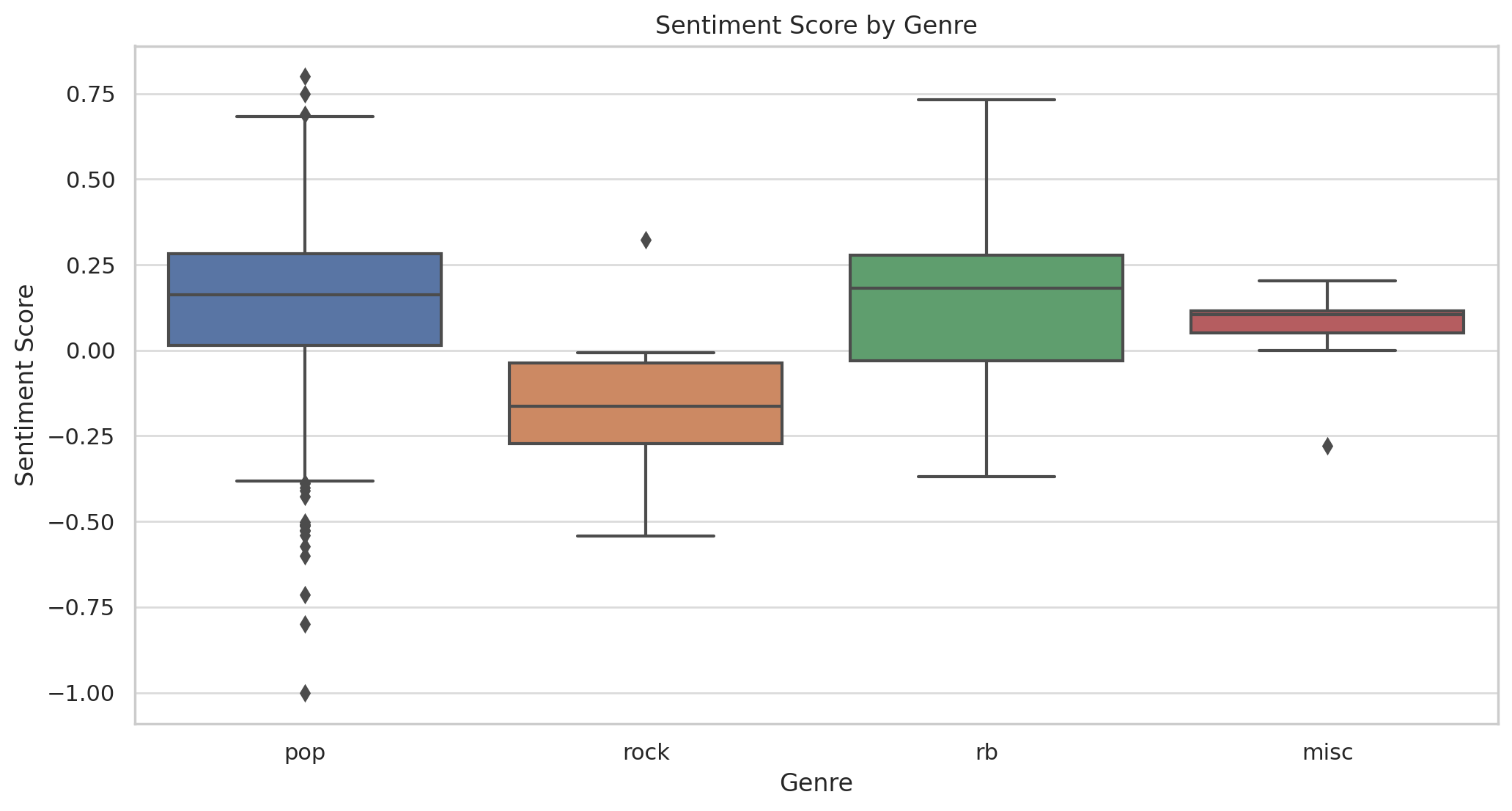
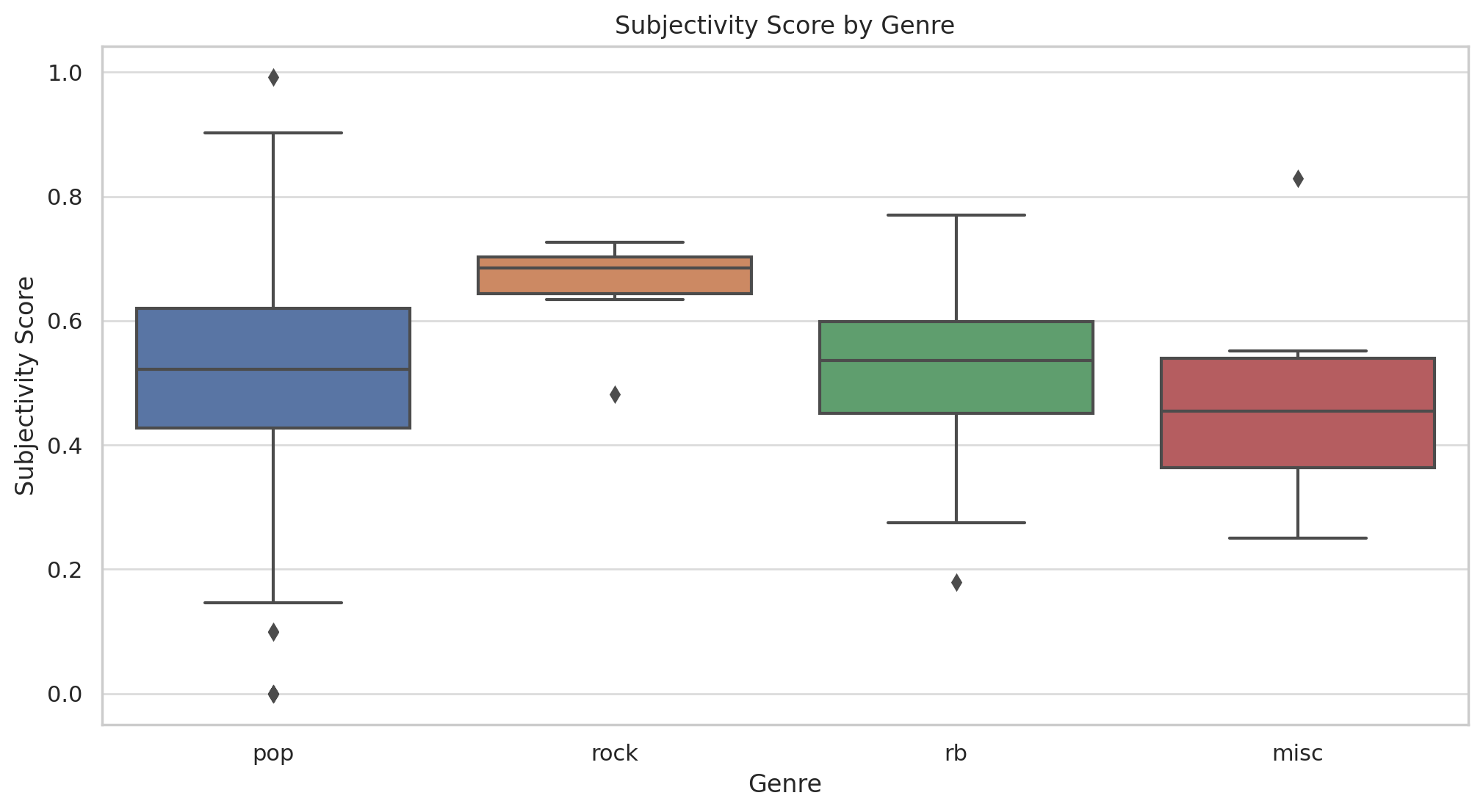
The analyses provide interesting insights into Michael Jackson's billboard charting songs over the years:
- Sentiment Over Time:The sentiment scores of Michael Jackson's songs show some fluctuation over the years. There's no clear linear trend, indicating that the emotional tone of his songs varied from year to year.
- Popularity vs. Sentiment:There doesn't appear to be a strong correlation between the sentiment scores and the popularity of the songs (as indicated by views). This suggests that the emotional tone of the songs may not be a significant factor in their popularity.
- Subjectivity Over Time:Similar to sentiment, the subjectivity scores also fluctuate over time. This indicates varying levels of subjectivity in the lyrics, without a clear trend towards more or less subjective content over the years.
- Genre Analysis:When examining sentiment scores by genre, it seems that different genres have varied sentiment profiles. However, due to the overlapping ranges, it's hard to conclude a strong distinction between genres based solely on sentiment scores.The subjectivity scores by genre also show variation, but again, there's significant overlap, suggesting that lyrical subjectivity is not strongly tied to a specific genre.
Overall, the data shows that Michael Jackson's songwriting style, in terms of emotional and subjective content, varied significantly throughout his career without a clear directional trend. Additionally, the popularity of his songs does not seem to be strongly influenced by their sentiment scores. However , we found some interesting outliers across all albums based on the sentiment analysis we performed on which we conduct further analyses:
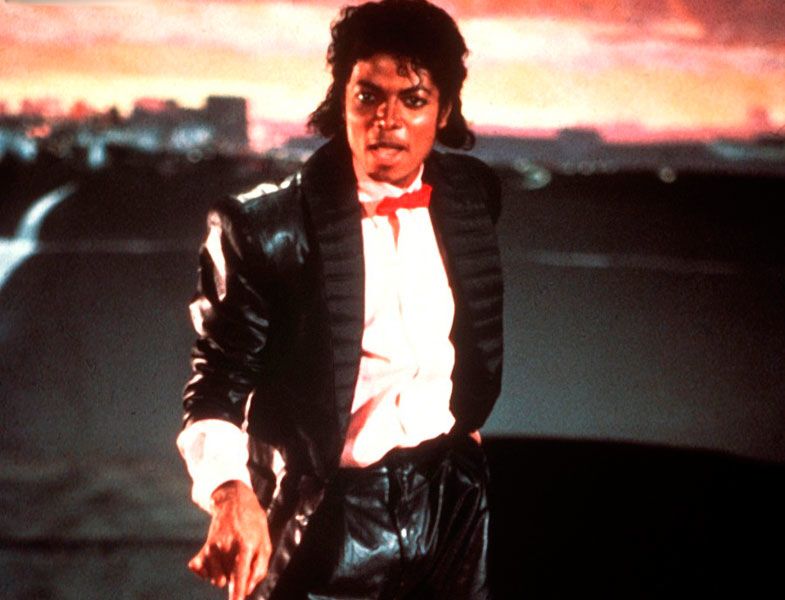
Billie Jean
"Billie Jean," one of Michael Jackson's most iconic tracks, was originally released in 1983 as part of his groundbreaking album, "Thriller." The song was written and composed by Jackson and produced by Quincy Jones. Its lyrics tell a story of a woman, Billie Jean, who claims that the narrator is the father of her son, a claim he denies. The song's narrative plays with themes of desire, fame, and the media's obsession with personal stories of public figures.
The sentiment and subjectivity of "Billie Jean" can be analyzed from both its lyrical content and its musical composition. The lyrics, dealing with issues of accusation and paternity, introduce elements of personal conflict and emotional turmoil, which may be reflected in sentiment analysis as more serious or negative. However, the driving beat and danceable rhythm create an upbeat musical sentiment that contrasts with the seriousness of the lyrics.
Subjectivity in the song is also an interesting point of analysis. The narrative is personal and introspective, possibly contributing to a higher subjectivity score. Yet, the song's universal theme of dealing with fame and false accusations may resonate broadly with listeners, thereby giving it a subjective yet relatable quality.

"It is Scary"
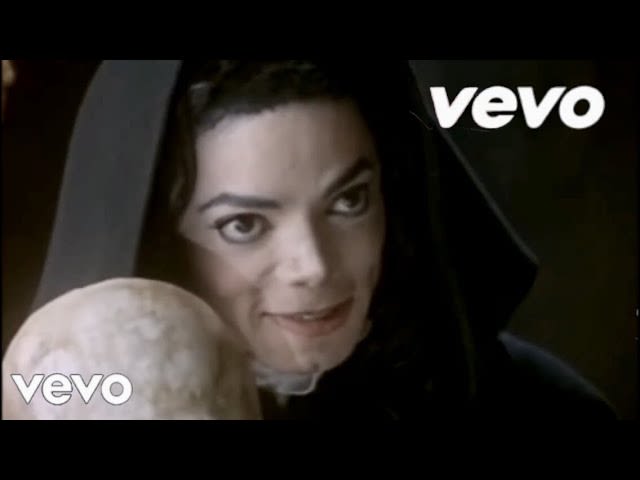
Is It Scary" is a track that showcases Michael Jackson's versatility and ability to tap into darker themes and tones in his music. Originally penned during the sessions for his 1995 album "HIStory: Past, Present and Future, Book I," the song was eventually released on the 1997 remix album "Blood on the Dance Floor: HIStory in the Mix." Critics have noted that the song revealed a darker side of Jackson than what was typically portrayed in the tabloids, with comparisons being drawn to the ghoulish rock style of artists like Marilyn Manson, suggesting a departure from his Motown roots to something more akin to pop gothic. This shift may reflect in the sentiment analysis as more complex and layered, potentially contributing to a high subjectivity score due to the personal and introspective nature of the lyrics.
The song's lyrical content delves into themes of fear, introspection, and confronting societal perceptions, which is mirrored in its haunting and dramatic musical composition. This thematic darkness and the emotive power of the music could explain the song's standout sentiment and subjectivity ratings in the data visualization.
"Is It Scary" was also associated with a short film that Jackson had planned to make with the same name, involving the collaboration with the renowned author Stephen King and special effects legend Stan Winston. However, the project was marred by controversy and was ultimately shelved due to allegations against Jackson that emerged during its production. The film was intended to explore the confrontation between Jackson's character and a mob of angry parents, pushing the boundaries of the artist's public persona and the media's treatment of his life and identity. The intense scenes required Jackson to react to verbal insults, aiming to capture a visceral response that would reveal a more vulnerable and aggressive side of him rarely seen by the public. This experience, which was intense for both Jackson and the extras involved, underscores the complex emotions and personal challenges Jackson faced, which could also resonate in the song's expressive sentiment.
As a song and a project, "Is It Scary" provides a window into Michael Jackson's artistic exploration of darker themes and his reaction to the often harsh spotlight of public scrutiny. The song's distinct presence in the tableau visualization can be attributed to its departure from Jackson's more mainstream work, touching on a raw nerve that both challenged and intrigued his audience.

"Stranger in Moscow"
Stranger in Moscow" is a poignant song by Michael Jackson that was lauded by critics for its haunting and ethereal qualities. Penned by Jackson during a turbulent period marked by intense personal scrutiny, the track stands out for its introspective and melancholic tone. It is one of Jackson's most personal and emotionally charged works, reflecting his feelings of isolation and desolation amidst the global fame he experienced. The song was so impactful that it altered the direction of his "HIStory" album, which was initially planned as a greatest hits collection but expanded to include a full studio album on the second disc due to the strength of this track.
The music critics recognized "Stranger in Moscow" as one of Jackson's finest ballads. Described as ethereal, the song was seen as a stirring portrayal of a man facing a swift downfall, walking under the shadow of the Kremlin, which symbolized the immense pressures and scrutiny Jackson felt at the time. The song was also likened to Jackson's earlier work, likening its depth and emotional weight to that of "Billie Jean." Notably, the song's chorus was highlighted for its melodic beauty and the emotive question it poses about how one feels when alone and cold inside.
"Stranger in Moscow" achieved commercial success, reaching the Top 10 in various countries and charting in over twenty nations. While it may not have matched the chart-topping heights of some of his other hits in the US, peaking at number 91 on the Billboard Hot 100, it was a hit by most standards and displayed Jackson's wide-reaching appeal.
The sentiment scores of "Stranger in Moscow" likely reflect the song's haunting and introspective nature. The somber mood, underscored by a feeling of isolation in the face of intense public scrutiny, is conveyed through the lyrics and the melancholic melody, possibly resulting in lower sentiment scores that capture the song's emotional weight. The track's deep introspection and nuanced portrayal of loneliness are elements that sentiment analysis would typically pick up as more negative due to their association with sadness and introspection.

Discography Analysis : Album by Album
While our initial exploration focused on the songs that graced the Billboard charts, Michael Jackson's artistic narrative extends far beyond these commercial successes. To truly appreciate the breadth and depth of his musical genius, we now turn our attention to an album-by-album analysis of his entire discography. This comprehensive approach allows us to delve into the nuances of each album, exploring the evolution of Jackson's artistry from his early years to his final works.
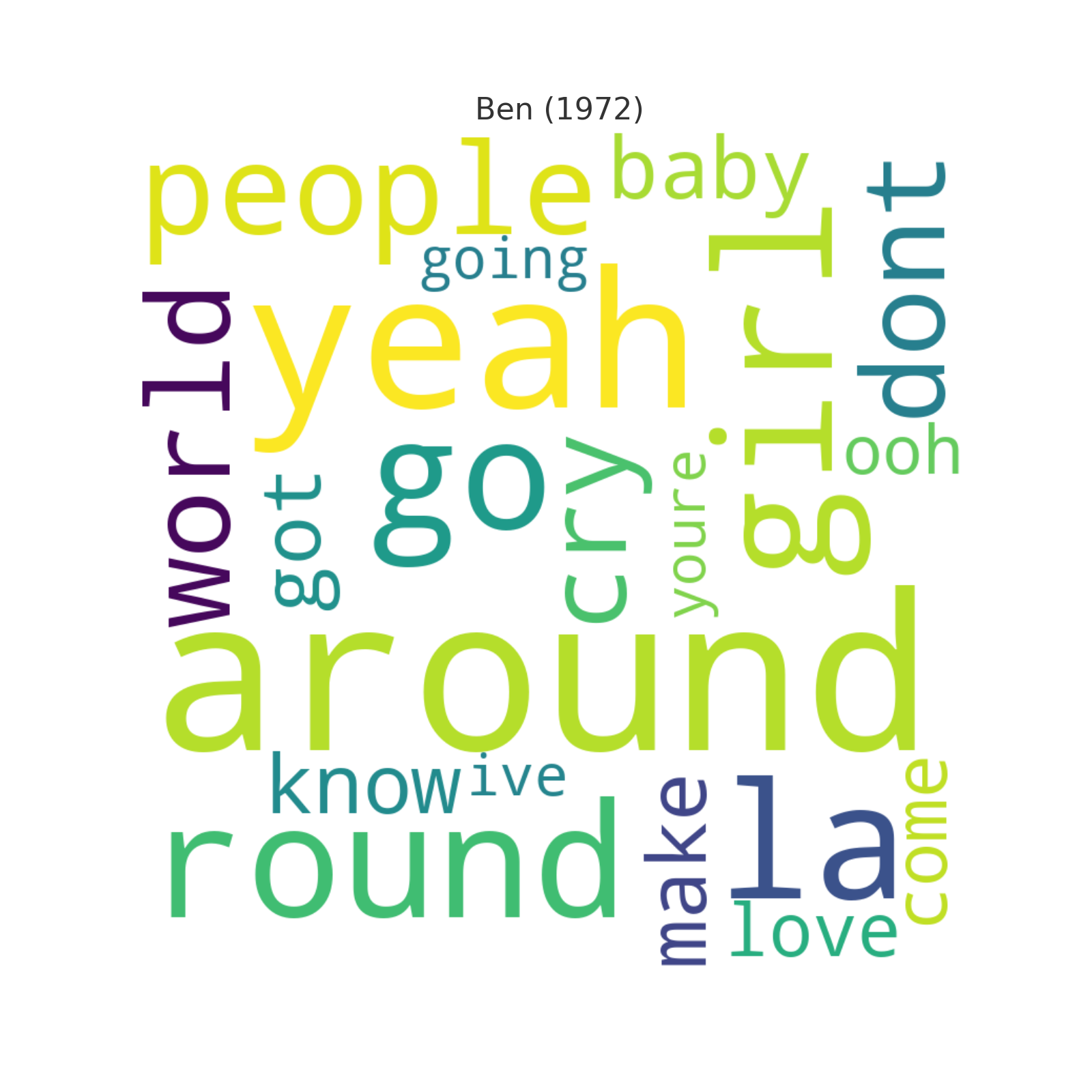
Ben(1972)
In this early work, words like "love," "girl," and "sunshine" paint a picture of youthful romance and optimism. The repetition of "got" and "back" suggests themes of longing and return, indicative of Michael's initial exploration into themes of attachment and desire.
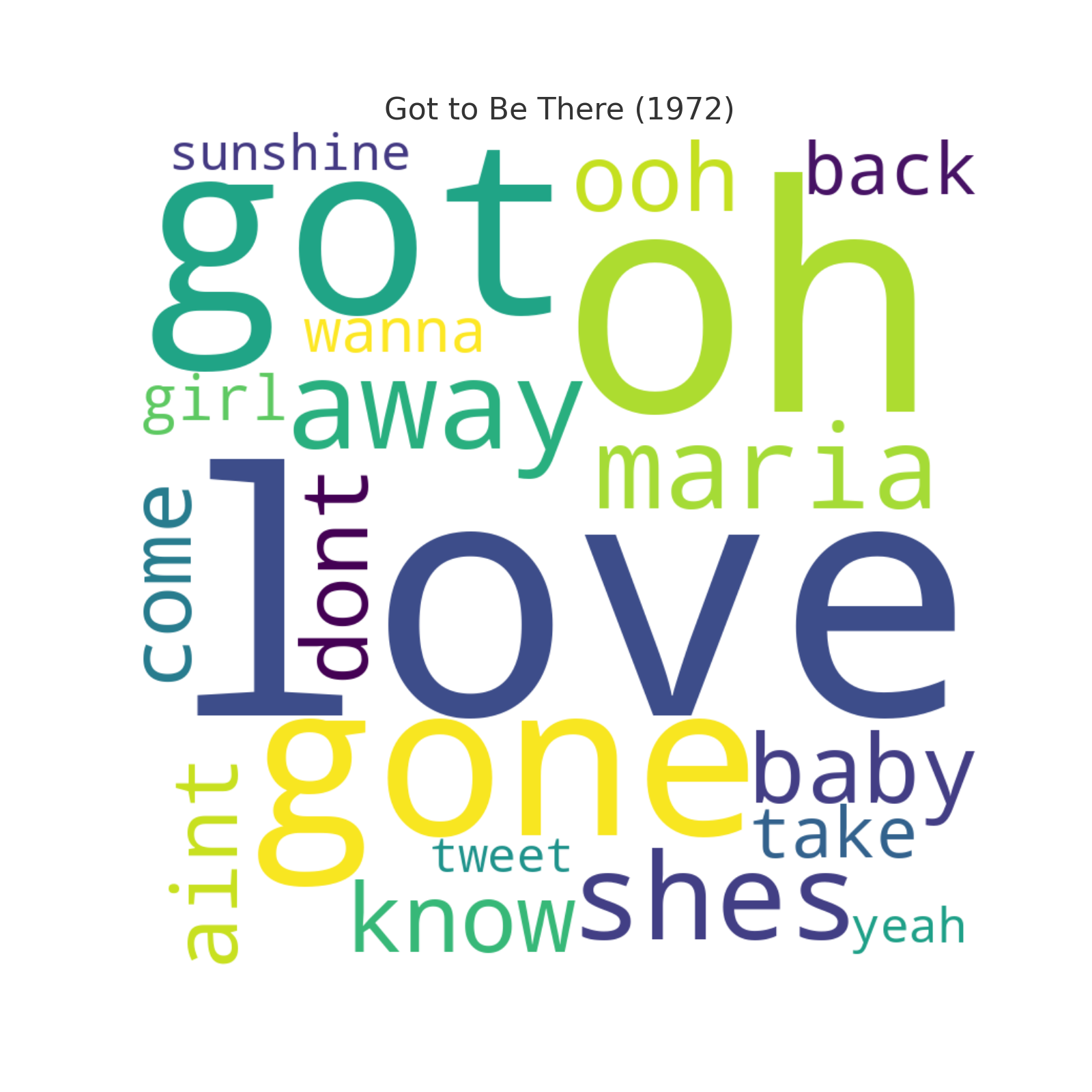
Got to be there(1972)
The word cloud from "Ben" reflects a sense of camaraderie and loyalty, with "friend" and "world" signaling a universal message of connection. The presence of words like "baby" and "cry" highlights Michael's sensitivity and emotional depth, even at this early stage.
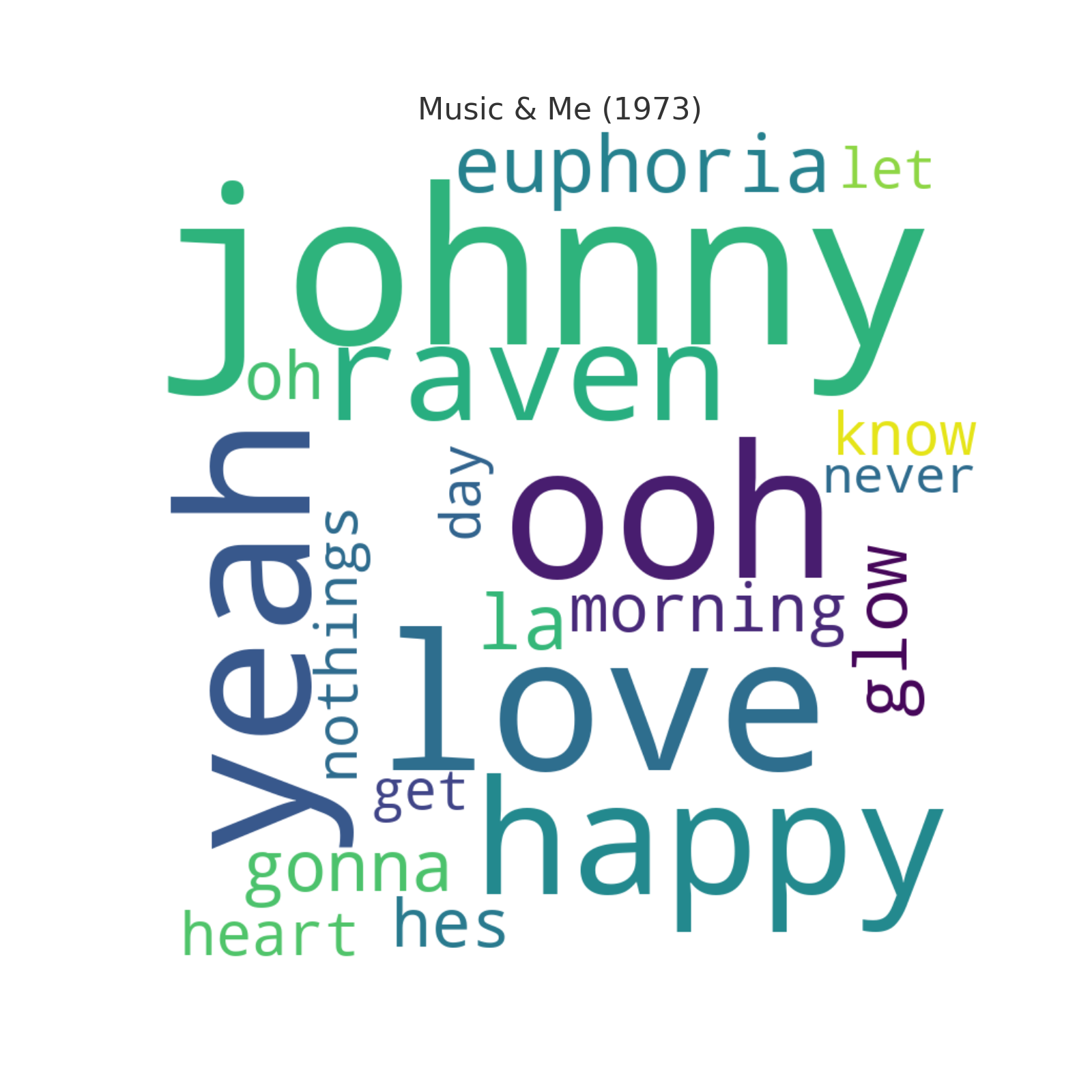
Music & Me (1973)
This album shows a shift toward introspection with "music" and "happy" suggesting a more personal and self-reflective tone. The use of "love" continues as a central theme, while "johnny raven" points to storytelling and character-driven narratives.
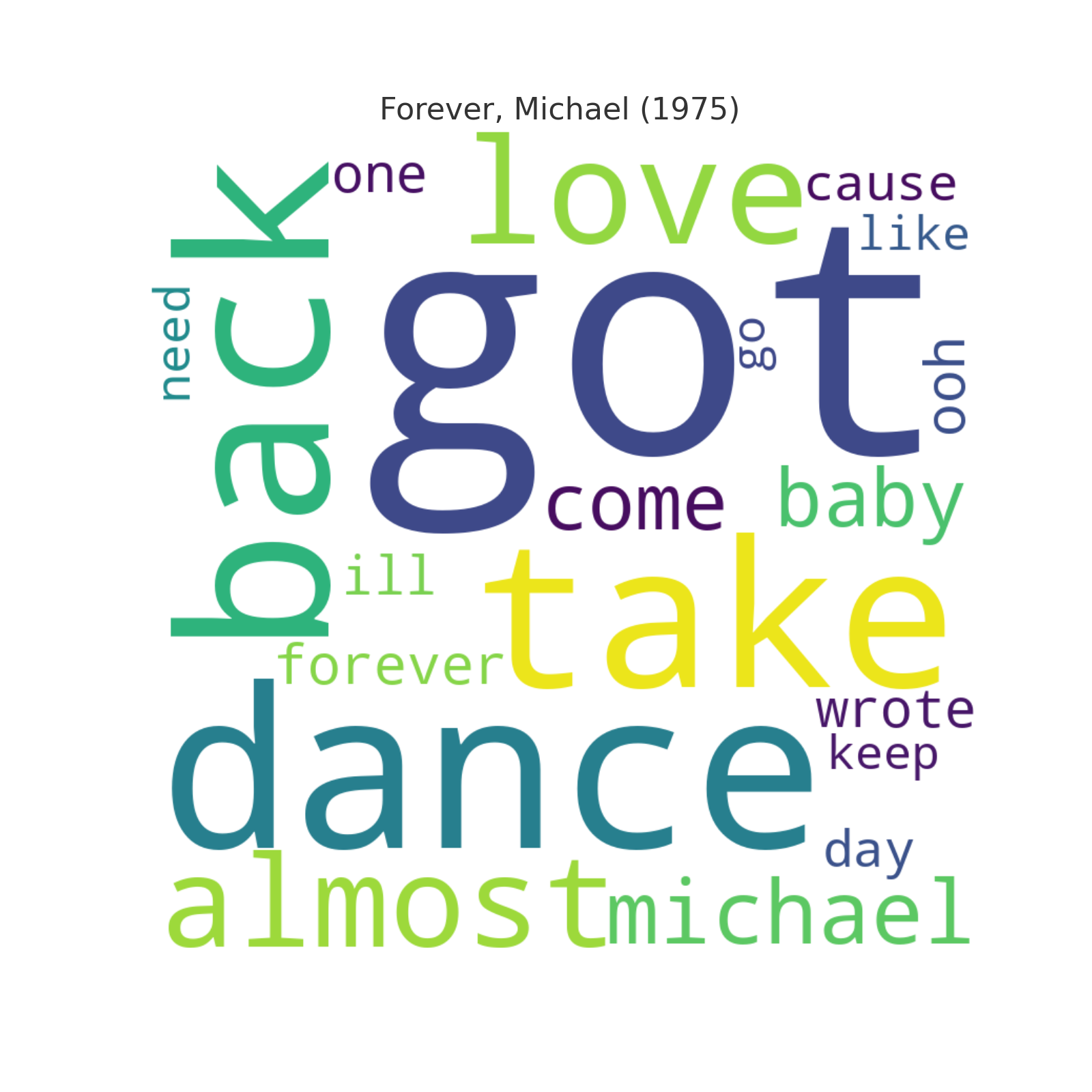
Forever, Michael(1975)
The words "love," "forever," and "baby" continue to recur, echoing enduring themes of love. "Dance" and "back" suggest a rhythmic and retrospective nature, hinting at Michael's deepening artistry and the development of a signature style.
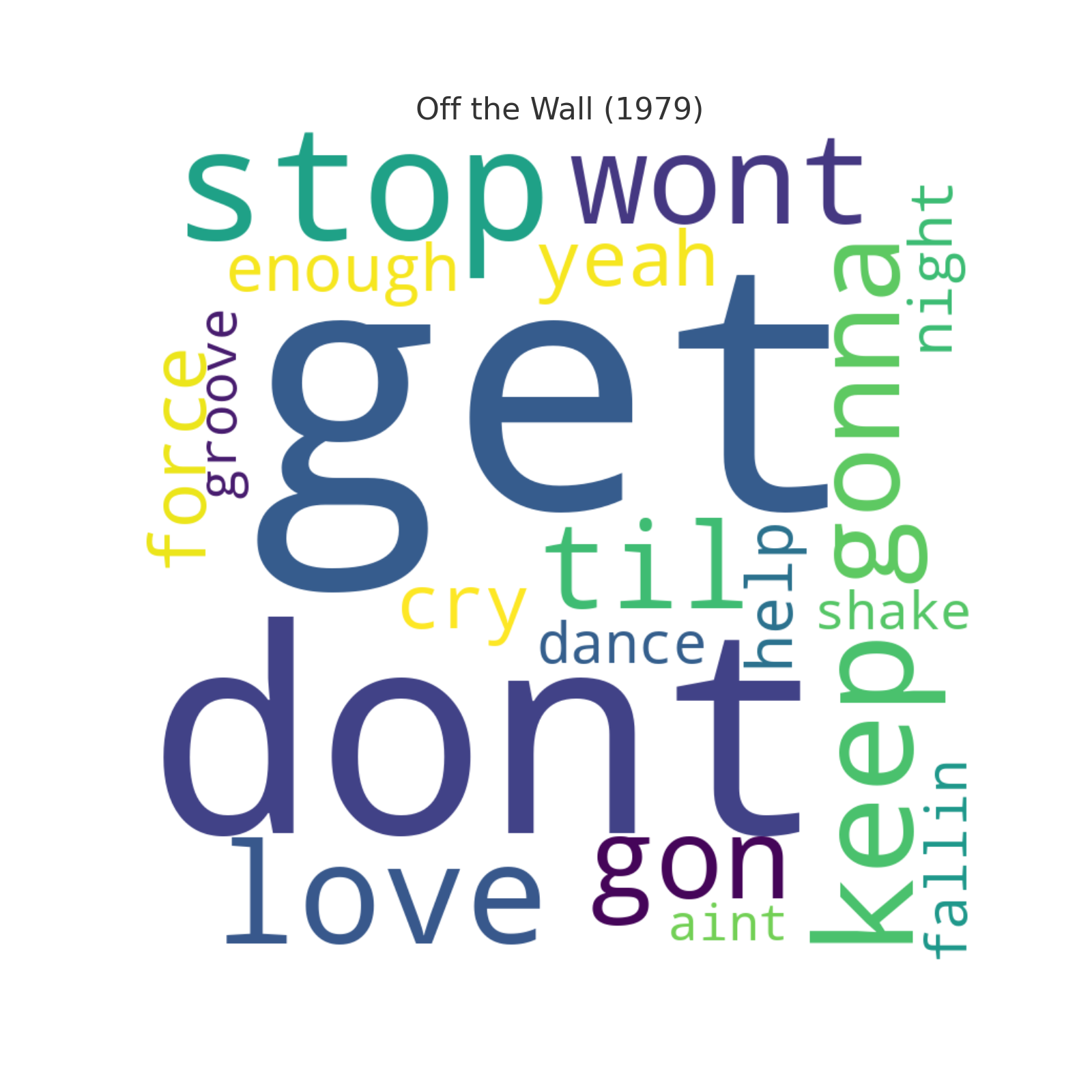
Off the Wall(1979)
Words like "dance," "night," and "get" evoke a vibrant, energetic atmosphere, resonating with the disco era's exuberance. The emphasis on movement and rhythm in this word cloud captures Michael's evolution into a more sophisticated and versatile artist.
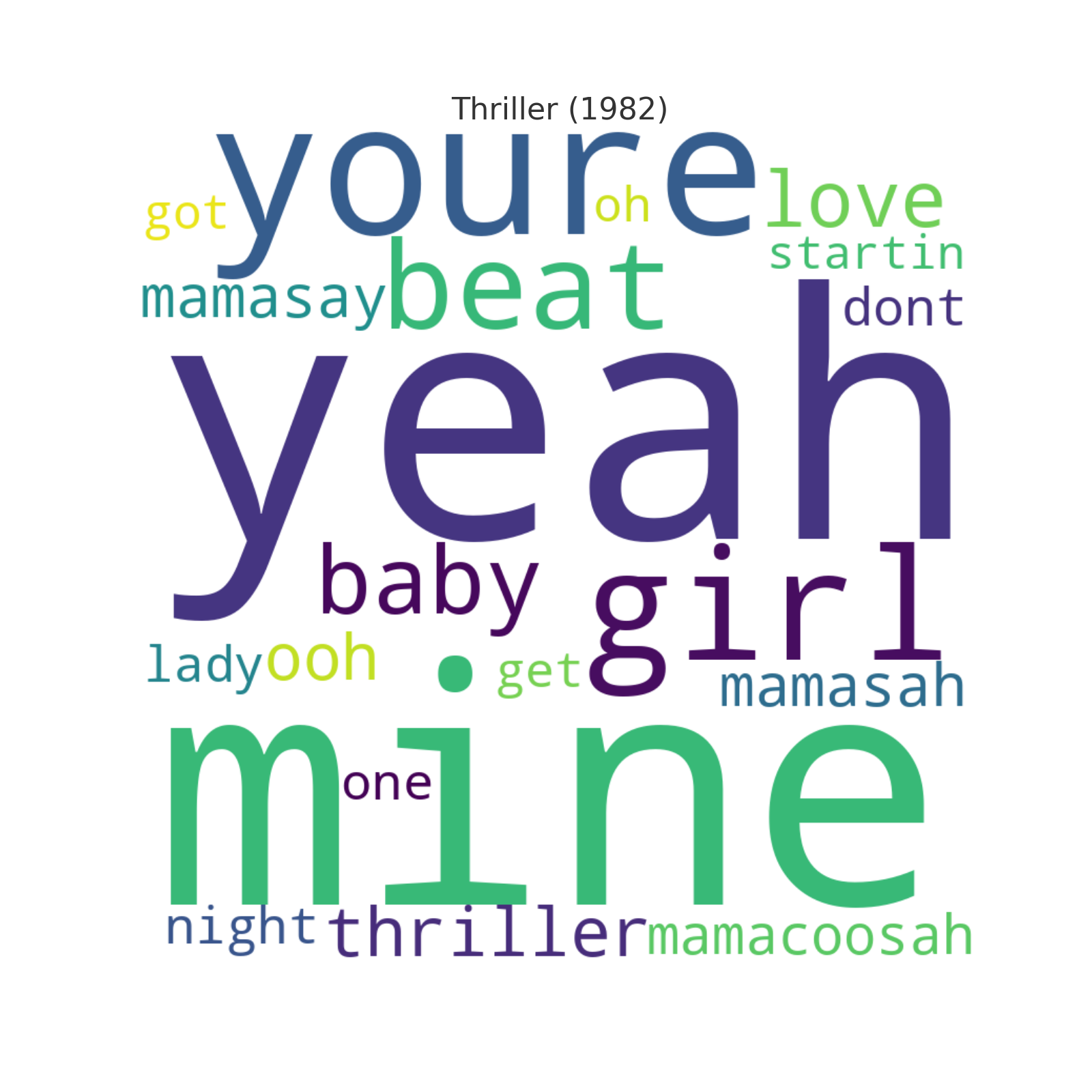
Thriller(1982)
In this iconic album's word cloud, "love," "girl," and "night" stand out, reflecting the blend of romance and mystique that Michael is known for. "Beat" and "thriller" underline the groundbreaking nature of the album, with an undercurrent of pulsating energy and innovation.
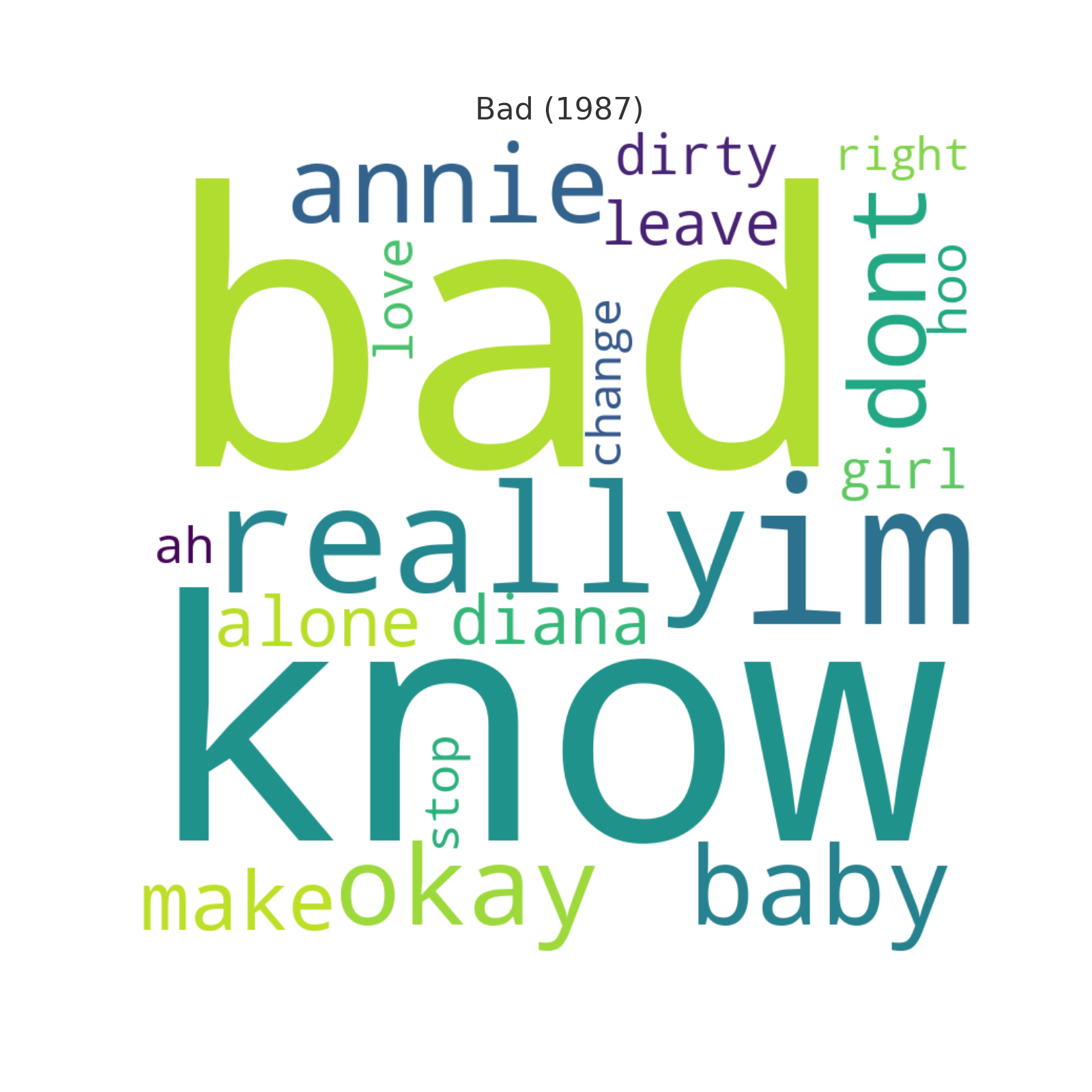
Bad(1987)
The boldness is clear with the prominent "bad" and "change," emphasizing Michael's self-assertion and evolution. "Annie," likely referencing "Smooth Criminal," shows a storytelling aspect, while "alone" and "girl" indicate themes of individuality and relational dynamics.
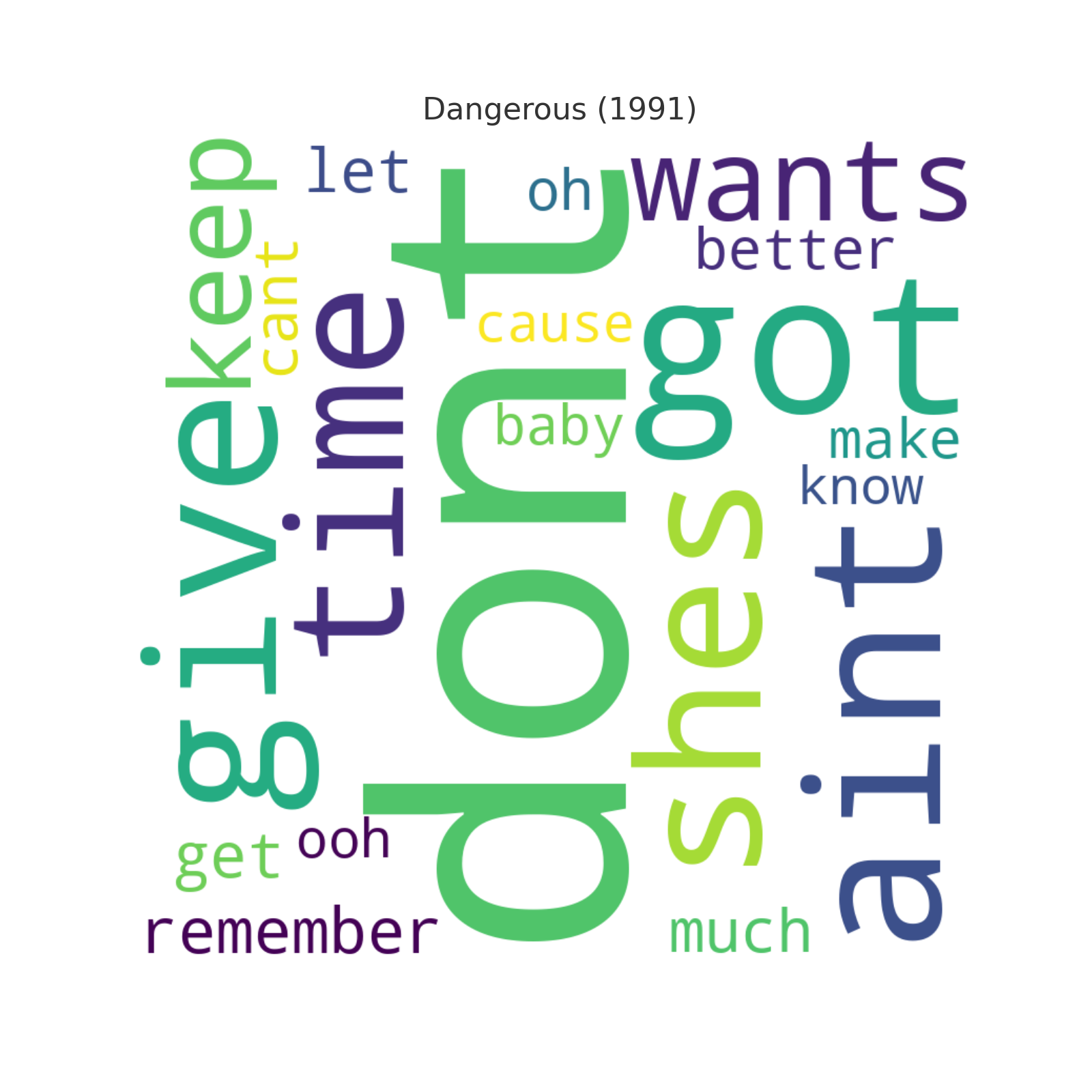
Dangerous(1991)
Words such as "time," "baby," and "world" indicate a fusion of personal relationships with broader societal commentary. "Dangerous" and "remember" suggest a complex interplay of risk-taking and nostalgia, marking a mature phase of self-expression.
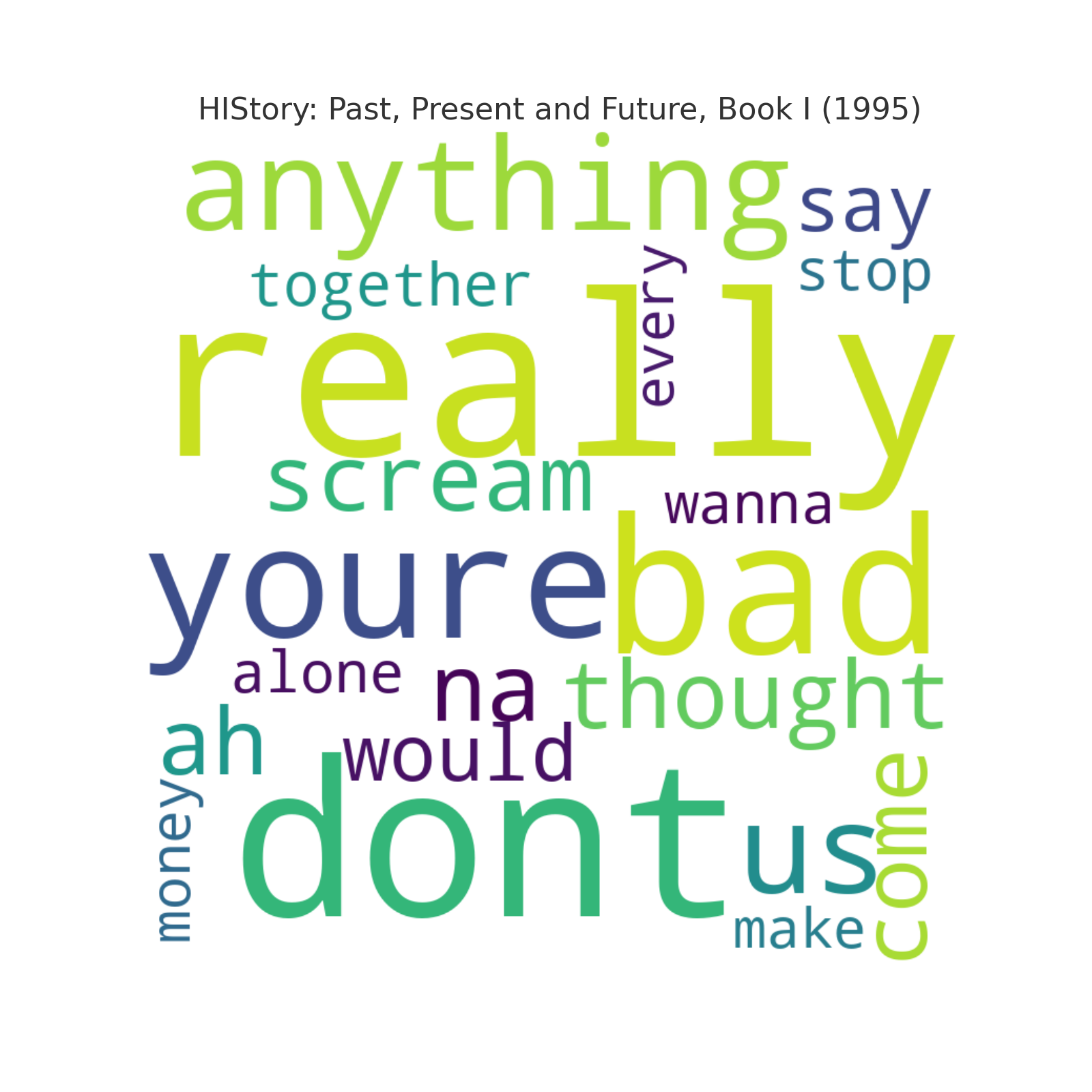
History(Past,Present and Future, Book I)1995
The word "scream" dominates, alluding to a confrontational and raw expression of emotions. "Alone" and "na" (from "They Don't Care About Us") could suggest feelings of isolation and a commentary on social injustice, while "anything" and "together" indicate a call for unity and strength.
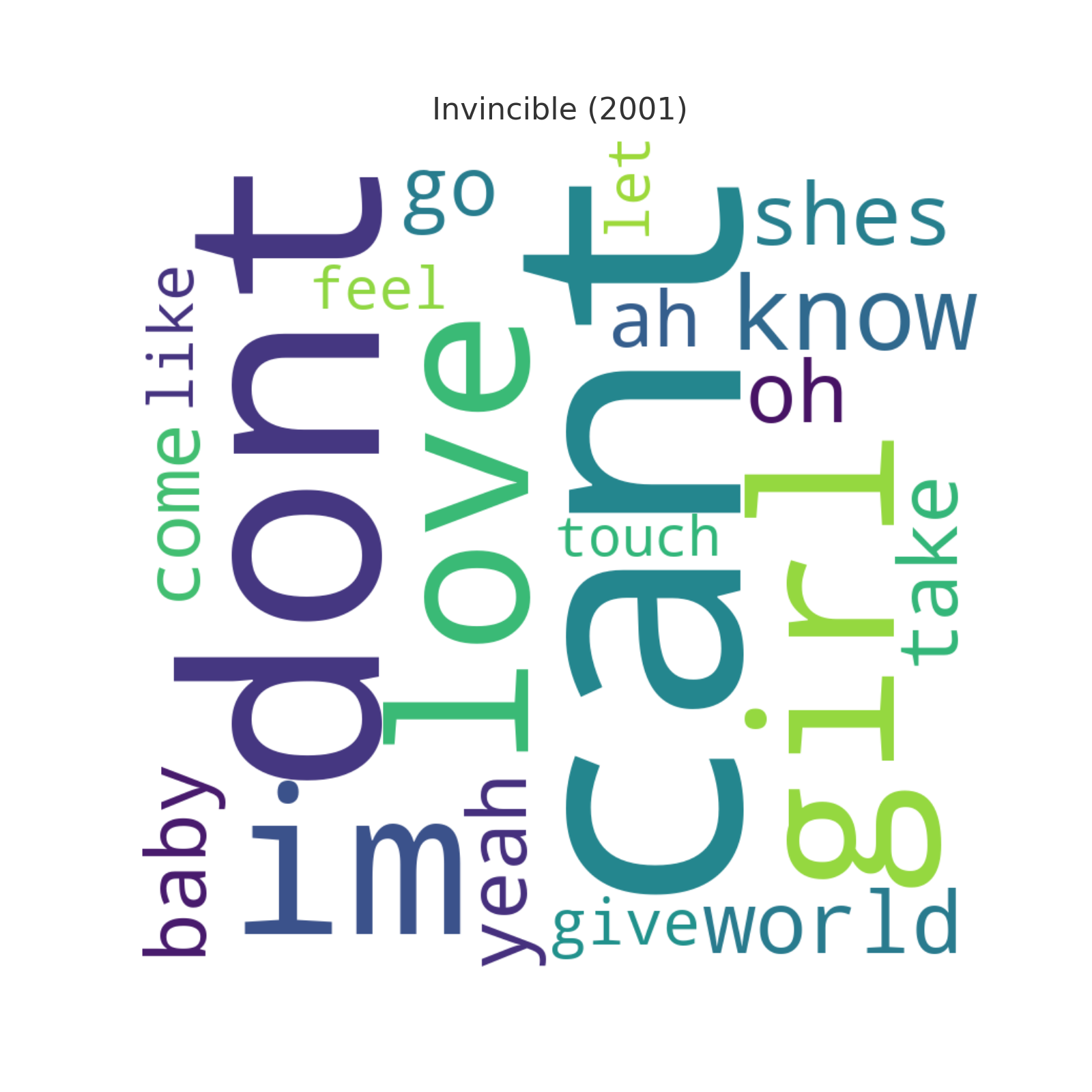
Invincible (2001)
In Michael's final studio album, "love," "world," and "baby" recur, speaking to enduring themes throughout his career. "Invincible" itself is less visible, but its essence is felt through words like "heart" and "feel," encapsulating Michael's lasting message of resilience and emotional connectivity.

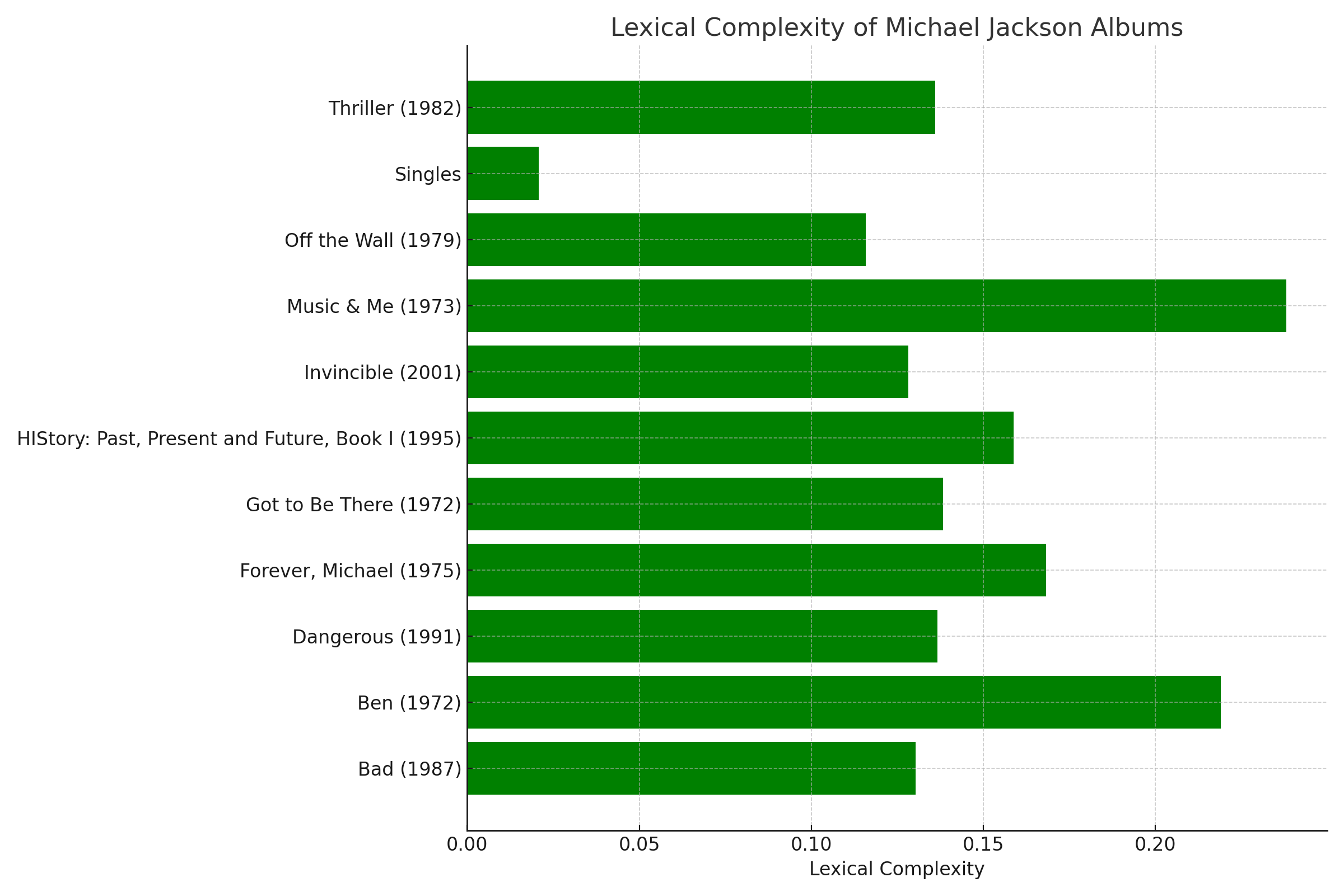
Lexical complexity of MJ's albums
The lexical complexity graph indicates variability in the diversity of Michael Jackson's vocabulary across his albums. "Thriller" stands out with the highest complexity, suggesting a rich variety of lyrics, which may be due to the wide array of themes and storytelling present in the album. Albums like "Music & Me" and "Invincible" show moderate complexity, indicating a balance between varied and recurring thematic content. Lower complexity in albums like "Ben" and "Bad" might reflect more focused thematic expression or the frequent use of certain signature phrases that define the mood and message of the album. It is also noteworthy that the two MJ studio albums with the highest lexical complexity are his first two.
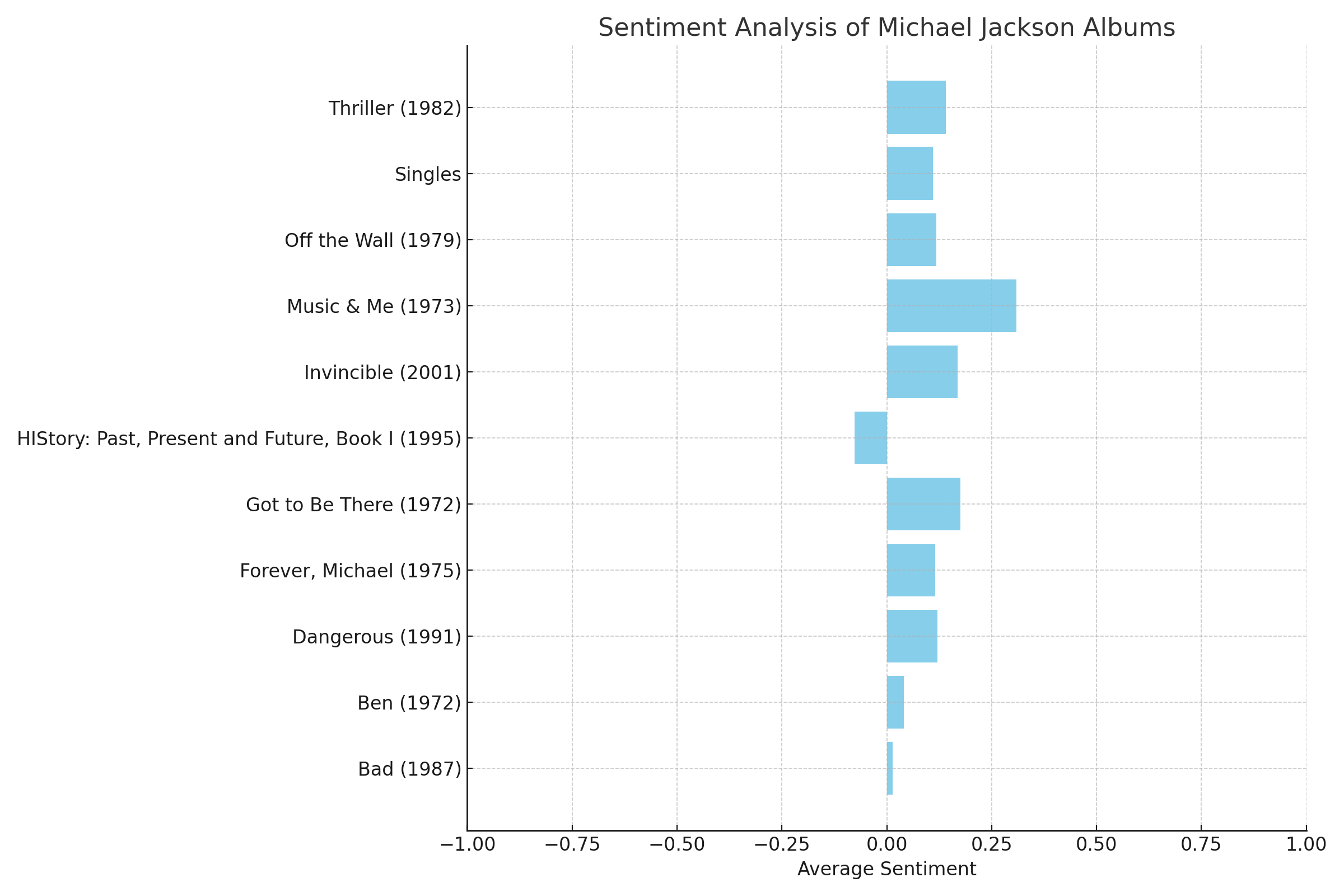
Sentiment Analysis By Album
The sentiment analysis graph shows a range of emotional expressions throughout Jackson's discography. "Thriller" and "Off the Wall" exhibit positive sentiment, likely reflecting the upbeat and lively nature of these iconic albums. "HIStory" and "Invincible" present a more neutral to positive sentiment, which might correspond to a mix of socially conscious lyrics and personal themes. Notably, "Bad" shows a negative sentiment, possibly indicating darker or more introspective themes within the album, contrasting with the confident and assertive public persona that the album title might suggest.

Through the analysis of word clouds, lexical complexity, and sentiment across Michael Jackson's discography, we gain a multi-dimensional view of his artistic evolution. The word clouds reveal a shift from simple, heartfelt themes of love and friendship in early albums like "Got to Be There" and "Ben," to more complex narratives and diverse themes in later works such as "Thriller" and "Bad," where words like "beat," "girl," and "mine" emerge, reflecting a deeper exploration of human experience.
The lexical complexity analysis underscores this evolution, with "Thriller" showing the highest diversity in vocabulary, indicating a creative zenith in Jackson's career. In contrast, other albums display a more focused lyrical approach with lower complexity, suggesting a concentration on central themes and motifs.
Sentiment analysis complements these findings, with the positive sentiments of "Off the Wall" and "Thriller" capturing the vibrant and optimistic energy of these periods, while albums like "Bad" show a dip into more complex emotional territories, revealing the nuanced and sometimes darker undertones of his later work.
Michael Jackson's lyrical journey is marked by an early emphasis on love and connection, a middle period of creative explosion and thematic diversity, and a later phase that combines introspection with a mature understanding of the complexities of life and society.
Data Critique
Datasets:
- Our Michael Jackson Timeline JS data consists of an overview of notable moments throughout Jackson's career and life. There is a breakdown of Jackson's most popular hits throughout his career, and the major events in his life. These data points will allow us to see a reoccurring theme which contributed to Jackson's path to success and popularity. The dataset however does not showcase things that fall outside of recorded music (live performances are an example of this).
- In our Voyant data set we were able to capture a number of observations. Our data showcases the most frequently used words in Michael Jackson's most popular songs and albums on Billboard. This data allows us to see that Jackson's songs hold five major themes which are: love, desire, wanting, perseverance, and his trademark slogan (hee-hee). The data also showed an increase in the amount of interjection words after he turned into a superstar after his "Off the Wall" album. However, the data does not allow for us to see songs that did not enter the Billboard charts for Jackson's music. In addition, when filtering for non-essential words, it is difficult as lyrics is fundamentally different from prose.
- (Sentiment Analysis) - the lyrical data we have scraped from Genius is only limited to words, and music is composed of different elements of sounds and instrument in addition to words. Thus, there are nuances in Michael Jackson's discography that cannot be captured solely by Lyrical Data. In this regard , our choice of data limits our analysis. In addition, performing Sentiment Analysis on pre-defined packages can yield relatively sub-par results as compared to training a Machine Learning model to capture nuances better. A project of this kind could be upscaled for better quality, typically requiring a months- long back and forth between computational experts and musical linguistic experts.
- Our Tableau Visualization, allows for us to showcase which years MJ's songs were actually the most popular (based on rankings, peak-rankings, and weeks on Billboard 100). Not only that, but there is another chart which showcases the total number of weeks on the Billboard Chart for all songs that entered the chart. And, the other chart showcases, the rankings with specific songs. These sources reveal how through 1980-1984 was Jackson's peak with his most popular songs. These data points allow for us to see just how impactful Jackson's songs were in the music industry. However, this data does not tell us anything for songs that did not appear on the Billboard Hot 100, or even made it to the charts.

Contributors Page :
Dagmawi Zerihun : Data Collection, Analysis, Visualization & Shorthand Design
Emily Porter : Word Frequency Analysis & Shorthand Design
Tien Duong : Word Frequency Analysis & Shorthand Design
Roger Gaillard : Interactive Timelines & Shorthand Design
Elijah Venos : Data Visualizations & Shorthand Design
Mark Moore : Shorthand Design & Project Manager
Works Cited (Images)
zƒce. Available at: https://www.behance.net/gallery/65457013/michael-jackson-moon-walk- (Accessed: 17 December 2023).
(No date a) Michael Jackson – ben (2009, 180 Gram, vinyl) - discogs. Available at: https://www.discogs.com/release/2957451-Michael-Jackson-Ben (Accessed: 17 December 2023).
(No date b) Michael Jackson: Biography, musician, dancer. Available at: https://www.biography.com/musicians/michael-jackson (Accessed: 17 December 2023).
Explore the best Billboardchart Art (no date) DeviantArt. Available at: https://www.deviantart.com/tag/billboardchart (Accessed: 17 December 2023).
Futurepedia, C. to (no date) Michael Jackson, Futurepedia. Available at: https://backtothefuture.fandom.com/wiki/Michael_Jackson (Accessed: 17 December 2023).
Greenburg, Z.O. (2014) Michael Jackson: King of pop, rock and soul--and hip-hop?, Forbes. Available at: https://www.forbes.com/sites/zackomalleygreenburg/2014/04/16/michael-jackson-king-of-pop-rock-and-soul-and-hip-hop/?sh=632d5643fdec (Accessed: 17 December 2023).
Michael album CD re-issued (no date) Michael Jackson World Network. Available at: https://www.mjworld.net/news/2022/07/09/michael-album-cd-re-issued/ (Accessed: 17 December 2023)
Michael Jackson -I can’t help it(anthony Nicholson Afrojazzboogiedelite Dub Mix) (no date) SoundCloud. Available at: https://soundcloud.com/miquifaye/michael-jackson-i-cant-help-itanthony-nicholson-afrojazzboogiedelite-dub-mix?in=smack787%2Fsets%2Fnuyorican (Accessed: 17 December 2023).
Michael Jackson off the wall [CD/DVD] new CD & DVD 888751244726 (no date) eBay. Available at: https://www.ebay.com/itm/145158722824?chn=ps&mkevt=1&mkcid=28 (Accessed: 17 December 2023)
Michael Jackson rocks the Maytag & Veils the kids (2014) Lisa’s History Room. Available at: https://lisawallerrogers.com/2010/06/26/michael-jackson-rocks-the-maytag-veils-the-kids/ (Accessed: 17 December 2023).
‘The jackson 5’ legendary R&B/Pop Music Group - 8x10 publicity photo (RT162) (no date) eBay. Available at: https://www.ebay.com/itm/113221271477 (Accessed: 17 December 2023).
Michael Jackson off the wall [CD/DVD] new CD & DVD 888751244726 (no date) eBay. Available at: https://www.ebay.com/itm/145158722824?chn=ps&mkevt=1&mkcid=28 (Accessed: 17 December 2023).
Michael Jackson’s thriller becomes first album to sell 30m copies in the US (2015) The Guardian. Available at: https://www.theguardian.com/music/2015/dec/17/michael-jackson-thriller-first-album-sell-30m-copies-us (Accessed: 17 December 2023).
Michael Jackson wheeled into hospital art print by bettmann (no date) Photos.com. Available at: https://photos.com/featured/michael-jackson-wheeled-into-hospital-bettmann.html?product=art-print (Accessed: 17 December 2023).
Bad (album) (2023) Wikipedia. Available at: https://en.wikipedia.org/wiki/Bad_%28album%29 (Accessed: 17 December 2023).
Lindquist, D. (2018) What Quincy Jones said about Indiana native Michael Jackson, The Indianapolis Star. Available at: https://www.indystar.com/story/entertainment/music/2018/02/07/what-quincy-jones-said-indiana-native-michael-jackson/317618002/ (Accessed: 17 December 2023).
Alonso, G. (2023) ‘are you a virgin?’: The Oprah Winfrey-Michael Jackson interview 30 years later, EL PAÍS English. Available at: https://english.elpais.com/culture/2023-02-21/are-you-a-virgin-the-oprah-winfrey-michael-jackson-interview-30-years-later.html (Accessed: 17 December 2023).
Grant, R.G. et al. (2016) The history book, Amazon. Available at: https://www.amazon.com/History-Past-Present-Future-Book/dp/B00004WX4P (Accessed: 17 December 2023).
Michael Joseph Jackson Jr. (aka prince or prince michael) (no date) Michael Joseph (Prince) :: True Michael Jackson. Available at: https://www.truemichaeljackson.com/man/fatherhood/michael-joseph-jackson-jr/ (Accessed: 17 December 2023).
Jackson, M. (2022) Among the many Guinness Records and awards Michael received - is the lifetime achievement award he received in 1993. pic.twitter.com/sifrmg8ia5, Twitter. Available at: https://twitter.com/michaeljackson/status/1490732095630495747 (Accessed: 17 December 2023).
Skynews (2009) Bid to give Micheal Jackson The nobel peace prize, Modern Ghana. Available at: https://www.modernghana.com/entertainment/9680/bid-to-give-micheal-jackson-the-nobel-peace-prize.html (Accessed: 17 December 2023).
Sisario, B. (2019) What we know about Michael Jackson’s history of sexual abuse accusations, The New York Times. Available at: https://www.nytimes.com/2019/01/31/arts/music/michael-jackson-timeline-sexual-abuse-accusations.html (Accessed: 17 December 2023).
Specialist: ‘I don’t know’ if Michael Jackson was a drug addict (2013) Los Angeles Times. Available at: https://www.latimes.com/local/lanow/la-xpm-2013-jul-03-la-me-ln-michael-jackson-trial-20130703-story.html (Accessed: 17 December 2023).
Five years later: Michael Jackson’s death (no date) Chicago Tribune. Available at: https://www.chicagotribune.com/entertainment/la-me-ln-five-years-michael-jacksons-death-photos-photogallery.html (Accessed: 17 December 2023).
Michael Jackson: Michael Jackson cartoon, Michael Jackson Art, Michael Jackson wallpaper (2018) Pinterest. Available at: https://www.pinterest.com/pin/michael-jackson--218283913175193331/ (Accessed: 17 December 2023).
Stranger in Moscow (Michael Jackson cover) (no date) SoundCloud. Available at: https://soundcloud.com/spaceshipsmusic/stranger-in-moscow-michael-jackson-cover?in=hlawuleko-mabasa%2Fsets%2Fmichael-jackson (Accessed: 17 December 2023).
Jones, L. (2013) 30 cool facts you didn’t know about ‘Billie Jean’, NME. Available at: https://www.nme.com/blogs/nme-blogs/30-cool-facts-you-didnt-know-about-billie-jean-766687 (Accessed: 17 December 2023).
Michael Jackson - is it scary (2019) YouTube. Available at: https://www.youtube.com/watch?app=desktop&v=R_0GFN3Mhd4 (Accessed: 17 December 2023).
Michael Jackson Peak. (n.d.). Vogue France. https://www.vogue.fr/fashion-culture/fashion-exhibitions/diaporama/michael-jackson-in-5-legendary-performances/36511
Michael Jackson Biography. (n.d.). Britannica. https://www.britannica.com/biography/Michael-Jackson
Book review: account of Michael Jackson’s rise and fall is fascinating and fair-minded. (n.d.). South China Morning Post. https://www.scmp.com/lifestyle/arts-entertainment/article/1872124/book-review-account-michael-jacksons-rise-and-fall
Annotated Biography
Cashmore, Ellis. 2022a. “Pact with the Devil .” Essay. In The Destruction and Creation of Michael Jackson. New York ; London ; Oxford ; New Delhi ; Sydney: Bloomsbury Academic.https://www.bloomsbury.com/us/destruction-and-creation-of-michael-jackson-9781501363566/
Annotation: This section of the book talks about how Jackson's career transitioned due to his lyrical content being more direct and outgoing. The evidence for the resource is an article by Today which states that MJ's lyrics told a hard story. The resource allows us to see how controversy and allegations around MJ could have potentially made a spike in his career. Furthermore, when MJ addressed the allegations it made a bold statement to the public, the lyrics themselves could have stuck out to the public thus making him more known.
Herman, Dewi Sri Lumbantobing, and Bloner Sinurat. “An Analysis of Figurative Language in Michael Jackson Song Lyrics.” Edu-Ling: Journal of English Education and Linguistics 4, no. 2 (July 30, 2021): 123–34. https://doi.org/10.32663/edu-ling.v4i2.1728.
Annotation:
Lecocq, Richard, and François Allard. 2018. Michael Jackson, All the Songs: The Story behind Every Track. New York, NY: Cassell Illustrated. https://www.barnesandnoble.com/w/michael-jackson-fran-ois-allard/1128934164
Annotation: This resource gives us insight on what MJ's music was like, from the lyrical content, to the actual music, we get to see it all unfold in this book. The Resource uses Michael Jackson's achievements and discography as evidence. This resource will allow us to see how the evolution of MJ going from a group to a solo artist, could of contributed to his success. Exploring the tracks and going in depth about the lyrical content will allow us to actually see which songs with the greatest lyrics correspond to his Billboard Chart entries.
Varnum, Michael E., Jaimie Arona Krems, Colin Morris, Alexandra Wormley, and Igor Grossmann. “Why Are Song Lyrics Becoming Simpler? A Time Series Analysis of Lyrical Complexity in Six Decades of American Popular Music.” PLOS ONE 16, no. 1 (2021). https://doi.org/10.1371/journal.pone.0244576.
Annotation: “Why are Song Lyrics Becoming Simpler?” argues that songs with more simplistic, repeating lyrics end up being more popular to a broader audience of people. This may be for multiple reasons, including it being easier to listen to and enjoy or a release in a year with more culturally impactful songs or events. This research gathered cross-temporal data covering a period of six decades (1958–2016) on lyrical compressibility (as an index of simplicity/complexity of song lyrics), amount of novel songs produced (as an index of available novel song choices), and ecological, socioecological, and cultural variables linked to patterns of cultural change in previous research or plausibly related to trends in aesthetic content. This is important for our paper for a few reasons. If the research in this paper is true, then we should be able to see that Michael Jackson’s most popular songs have lyrics that are either easily understood and repeated or have word choices that have an impact because of culturally significant events at the time.
Warwick, Jacqueline. "You can't Win, Child, but You can't Get Out of the Game": Michael
Jackson's Transition from Child Star to Superstar." Popular Music and Society 35, no. 2 (2012): 241-259.
Annotation: The articles examined the changes in Michael Jackson's performance styles when he was a child and when he became an adult by analyzing changes in his life that create mental changes which lead to the influences in his performing styles. Since our project also tracks changes in Michael Jackson's music, it would be interesting to see if we could identify any similar or different influences between his performing style and music lyrics.
Brown, Geoff. Michael Jackson: A Life In Music: A Life in Music. Omnibus Press, 2010. 5-23
Annotation: The book included a timeline of important events in Michael Jackson's life and music career since he first started as a member of Jackson 5 to when he became a soloist. Since our project is looking for changes in Michael Jackson's song lyrics, this timeline would be helpful to see if there were any related events that could possibly influenced him or being influenced by his change in music.
Pratama, Muhammad Adi. “Phrase and Clause Usage in Michael Jackson’s Song Lyrics.” Lexicon 4, no. 1 (2015): 32–39. https://doi.org/https://doi.org/10.22146/lexicon.v4i1.42133.
Annotation: This article demonstrates the usage of common phrase structures and clause usages in Michael Jackson’s most popular songs. For evidence, Pratama bases his study on Eastwood’s categories of phrase and clause types, and he uses Jackson’s song lyrics as his primary evidence of study. For our project specifically, this article shows the development of certain sentence structures that go into Jackson’s lyrics and how noun phrases are the most common structure in his lyrics. This could be interesting to explore further in his lyrics and how the subject or “thing” that Jackson sings about impacts his songs.
Blais-Rochette, Camille, Dave Miranda, Marc-André Goulet, and Patrick Gaudreau. “Songs as a Way of Listening to Cultures across Generations? A Comparison of Canada and the United States through Their Famous Songs from 1975 to 2017.” Psychology of Aesthetics, Creativity, and the Arts 16, no. 2 (2022): 370–85. https://doi.org/https://doi.org/10.1037/aca0000347.
Annotation: This article studies the cultural impacts of the lyrics of popular songs in the USA and Canada to examine cross-cultural and cross-generational differences in societies. The researchers reference a variety of psychological studies regarding music and mood in different cultures, the role of music in society, and musician resources and lyrics. For our project, this source provides insight into how music can affect a group of people living in a certain place. We can use this article to study the changing lyrics in Michael Jackson’s songs, like references to certain people, swearing, etc.
Vogel, J. (2015a, March 20). “the misunderstood power of Michael Jackson’s music.” the Atlantic. February 8, 2012. Academia.edu. https://www.academia.edu/11495091/_The_Misunderstood_Power_of_Michael_Jacksons_Music_The_Atlantic_February_8_2012.
Annotation: The article argues that Michael Jackson aimed to be the best in his field, evidenced by his response to the slight of his album "Off the Wall" at the Grammy Awards, which fueled his resolve to create the record-breaking album "Thriller". The article uses historical context, sales records, critical responses, and comparisons with other prominent artists to substantiate its arguments about Michael Jackson's career trajectory and the critical reception of his work. This source is particularly valuable for our research project as it highlights the complexities in understanding Jackson's musical and lyrical evolution. It underscores the challenge of analyzing his lyrics purely on a textual basis, noting that Jackson's artistry was deeply rooted in the African-American tradition.
Hutajulu, Willy Cardo, Oscar Pardomuan Butarbutar, Jeremia Situmorang, Silvia Torong, Vistan
Sebasty Situmeang, and Herman Herman. 2023. “EXAMINING THE DISCOURSE ANALYSIS ON THE SONG LYRIC ENTITLED ‘HEAL THE WORLD’ BY MICHAEL JACKSON”. Jurnal Scientia 12 (01), 269-79. https://doi.org/10.58471/scientia.v12i01.1093.
Annotation: This research article aims to explore the contextual, grammatical, and lexical aspects of Michael Jackson's song "Heal The World.” The article utilizes discourse analysis, a method that examines the relationship between text and context, including the situational and cultural conditions, social practices, and ideological representations involved in the production of texts. This article is particularly useful for our research project as it provides a methodological framework for analyzing Michael Jackson's lyrics. By demonstrating the importance of considering the contextual elements in understanding the lyrics.
Amisu, Elizabeth. The Dangerous Philosophies of Michael Jackson: His Music, His Persona,
and His Artistic Afterlife. Santa Barbara, California: Praeger, 2016. https://go.exlibris.link/D9FL0q1l
Annotation: "The Dangerous Philosophies of Michael Jackson: His Music, His Persona, and His Artistic Afterlife" explores Michael Jackson's far-reaching impact as an artist, arguing that his influence goes beyond music and delving into his philosophical approach as an artist, his public persona, and the lasting resonance of his art. Supported by 21 academic essays, the book offers extensive analysis and insights into various facets of Jackson's career, providing valuable context for our lyrical analysis project on his Billboard-topping songs. It not only helps interpret the themes and creative elements in his music but also places his work within broader cultural debates, enriching our project's exploration of his lyrics and their cultural significance.
 Built with Shorthand